
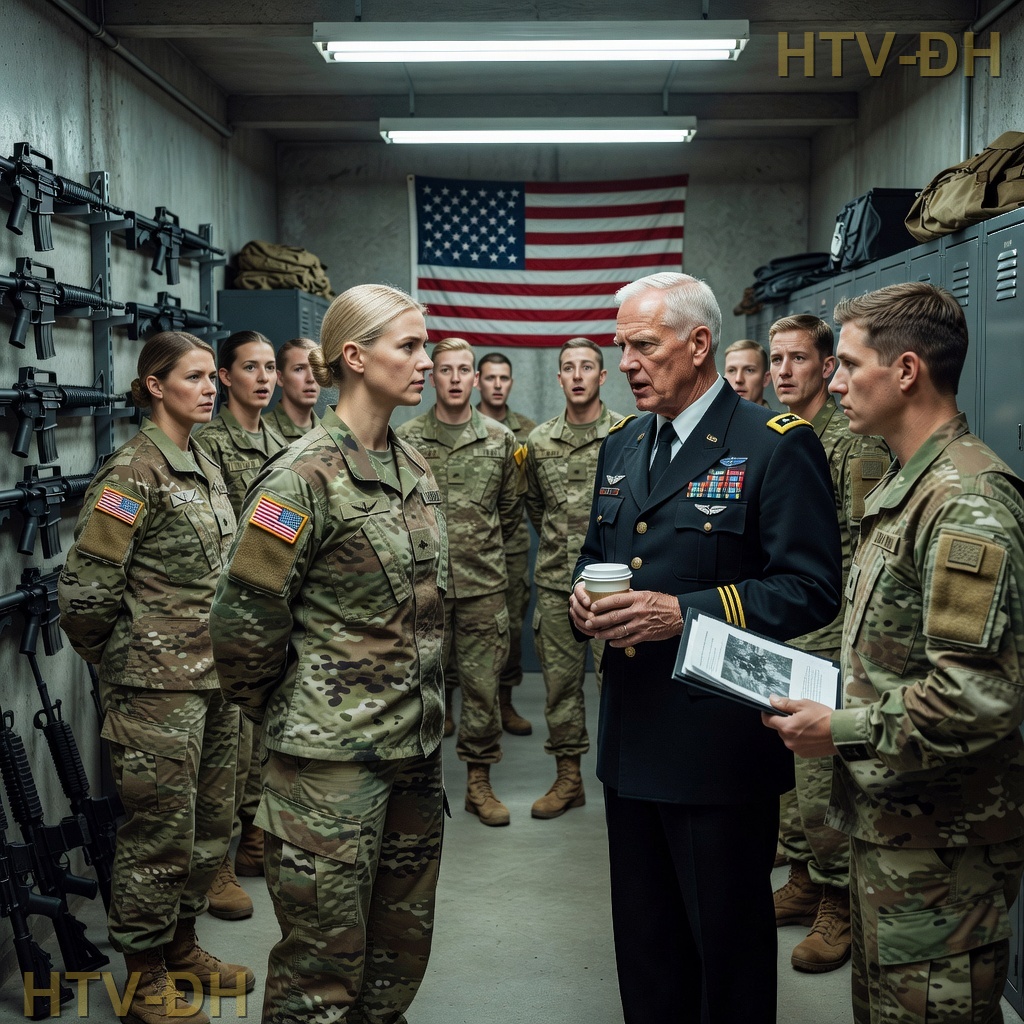
The general ordered me to remove my sniper badge – then a classified file made him apologize in front of everyone…
The general walked past my rifle as if I were a piece of furniture.
Then he saw the small black badge above my pocket.
3,200 meters. Confirmed.
His coffee stopped halfway to his mouth.
In the entire armory, every soldier went silent.
And for the first time in my career, the man with the many stars looked afraid.
PART 1 – THE BADGE HE THOUGHT WAS A LIE
The general didn’t notice me until the number on my chest made him look foolish in front of his entire staff.
That’s how it started.
Not with gunfire.
Not with a slow-motion battlefield memory.
Just a Tuesday afternoon at Camp Liberty, Kentucky, with buzzing fluorescent lights overhead, CLP oil on my gloves, and a three-star general holding a Starbucks cup as if it were part of his uniform.
I was sitting in the back corner of the armory, where no one usually bothered me.
That was the point.
Give me a workbench, my Barrett .50, a box of cleaning patches, and silence, and I could be invisible for hours.
Most people loved being seen.
I had built a career on the opposite.
My name was Staff Sergeant Luna Valdez, but most on the base called me Ghost.
Not because I asked them to.
The Army loves nicknames the way airports love delays. Once one sticks, you’re done.
I was twenty-nine, five deployments deep, and very tired of officers who thought volume was leadership.
That afternoon, General William Matthews came through the armory for his weekly walkthrough.
He had that posture that told you he hadn’t opened his own car door since 2008.
Behind him came Lieutenant Colonel Harrison, two majors, a captain with a tablet, and a nervous public affairs officer who kept smoothing his tie as if the tie had personally betrayed him.
They moved through the room with clipboards and polished boots.
Weapons racks.
Maintenance logs.
Safety regulations.
Same theater, different cast.
I kept working.
The Barrett was already disassembled in front of me. Bolt carrier group cleaned. Chamber inspected. Optics covered. Parts laid out in a line so neat it made new privates uneasy.
Matthews barely looked at me.
That was normal.
Women in armories are either ignored or tested.
Sometimes both before lunch.
“Carry on, soldier,” he said, already walking past.
“Yes, sir.”
I didn’t look up for more than half a second.
Then he stopped.
Not slowed down.
Stopped.
His boots squeaked on the concrete.
For a moment, the only sound in the armory was a private scrubbing carbon off an M4 as if his future depended on it.
General Matthews turned to me.
His eyes moved to my uniform.
Not to my rank.
Not to my name tape.
To the badge.
Small. Black. Easy to miss.
Unless you knew what it meant.
His mouth went thin.
“Staff Sergeant.”
I set down the brush.
“Yes, sir?”
He leaned in closer, as if the embroidery might rearrange itself if he stared long enough.
“Who awarded you this badge?”
I already knew where this was going.
“Army Special Operations Command, sir.”
His jaw tightened.
“Don’t get smart.”
A few soldiers looked over.
No one likes watching a general get irritated – unless you’re not the target.
I was definitely the target.
Matthews tapped the air near the badge, careful not to touch me.
“This says 3,200 meters confirmed.”
“Yes, sir.”
“That’s not possible.”
I wiped oil off my glove with a rag.
“Apparently it was a busy day for the possible, sir.”
Someone behind him coughed.
Or laughed.
Hard to tell.
Matthews looked over his shoulder, and the armory went dead silent again.
He turned back to me.
“I’ve served twenty-seven years. I’ve worked with Rangers, SEALs, Delta support teams, Marine snipers. No one makes that shot.”
I met his eyes.
“Then your list must have been incomplete.”
That got the room’s attention.
Harrison’s eyebrows went so high they almost qualified for flight pay.
The captain with the tablet stopped mid-scroll.
Matthews smiled, but it wasn’t friendly.
It was the kind of smile powerful men use when they’re deciding whether to destroy you now or after the witnesses leave.
“Staff Sergeant Valdez,” he said, reading my name tape, “are you telling me you made the longest confirmed sniper kill in U.S. military history?”
“No, sir.”
His smile widened.
“Good.”
“I’m telling you the badge says what command authorized it to say.”
That smile disappeared.
Beautiful.
I went back to cleaning the bolt.
Matthews didn’t move.
“Stand up.”
I stood up.
Not fast.
Not slow.
Just enough to remind him I understood rank and still had a spine.
He studied me like he was looking for the part of me that matched the story he expected.
I wasn’t six feet tall.
I wasn’t built like a recruiting poster.
I had a faded scar on my chin, dark hair pulled into a regulation bun, and tired eyes that made bartenders ask if I wanted coffee instead of whiskey.
I didn’t look like a legend.
That offended him.
“Where did you serve?” he asked.
“Multiple locations, sir.”
“That’s not an answer.”
“It is when the rest is classified.”
Harrison jumped in, eager to be useful.
“General, I can pull her basic file.”
“Do it.”
The captain with the tablet handed Harrison the device like a priest handing over scripture.
Harrison tapped through my file.
His face changed.
That was always the best part.
First, officers read my file like they expected a typo.
Then the schools show up.
Sniper school.
Advanced long-range precision.
Reconnaissance programs with redacted names.
Joint task force assignments.
Awards with citations hidden behind classification levels.
Deployments listed only as “operational support.”
Harrison swallowed.
“Sir…”
Matthews didn’t look away from me.
“Read it out loud.”
“Staff Sergeant Valdez graduated top of her sniper course. Highest practical score in that cycle. Multiple advanced courses. Previous attachments to Ranger units, special mission support, and…” Harrison paused. “Several restricted assignments.”
Matthews held out his hand.
Harrison gave him the tablet.
The general read in silence.
His thumb stopped scrolling twice.
Then three times.
The armory had completely stopped pretending to work.
I could feel every pair of eyes.
Private First Class Miller, working two benches over, was still holding the same cleaning patch he’d had for a full minute.
I looked at him.
He started scrubbing again immediately.
Matthews lowered the tablet.
“If this is real, why are you sitting in a corner cleaning your own rifle like no one knows who you are?”
I picked up the bolt carrier group.
“Because it’s dirty, sir.”
His staff shifted uncomfortably.
A major stared at the floor.
Harrison looked like he wanted to be anywhere else. In line at the DMV. Getting a colonoscopy. In a middle seat on Spirit Airlines.
Matthews stepped closer.
“You think this is funny?”
“No, sir.”
“You think I like finding questionable awards on soldiers under my command?”
“I wouldn’t know what you like, sir.”
His eyes went hard.
The man was used to fear.
Fear makes people over-explain. Apologize. Shrink.
I had spent too many nights in places without streetlights to be impressed by indoor anger.
Matthews pointed at my badge.
“Until I verify this, you will remove it.”
“No, sir.”
The entire armory took a breath.
Matthews went still.
“Excuse me?”
“I said no, sir.”
His voice dropped.
“Staff Sergeant, you are one bad decision away from ending your career in this room.”
I looked at the badge.
Then at him.
“With all due respect, sir, this badge was signed by people who outrank both of us.”
That landed.
Not because I raised my voice.
But because I didn’t.
Matthews went red in a controlled, expensive way.
Harrison leaned in and murmured, “Sir, we should probably check before taking action.”
Matthews ignored him.
He stared at me for five long seconds.
Then he said the sentence that turned a routine inspection into the worst week of his career.
“Fine. If you’re so confident, Staff Sergeant, then you can prove it.”
I set down the cleaned part.
“Prove what, sir?”
“That the Army didn’t accidentally pin a fairy tale to your chest.”
I almost smiled.
Almost.
“Careful, General.”
His eyes narrowed.
“Careful?”
“Yes, sir.”
I leaned in just far enough for him to hear me without the room catching every word.
“Some fairy tales have witnesses.”
————————————————————————————————————————
The general walked past my rifle as if I were a piece of furniture.
Then he saw the small black pin above my pocket.
3,200 meters. Confirmed.
His coffee stopped halfway to his mouth.
In the entire armory, every soldier went silent.
And for the first time in my career, the man with many stars looked afraid.
PART 1 — THE PIN HE THOUGHT WAS A LIE
The general didn’t notice me until the number on my chest made him look foolish in front of his entire staff.
That’s how it started.
Not with gunfire.
Not with a slow-motion memory of the battlefield.
Just a Tuesday afternoon at Camp Liberty, Kentucky, with fluorescent lights humming overhead, CLP oil on my gloves, and a three-star general holding a Starbucks cup as if it were part of his uniform.
I was sitting in the farthest corner of the armory, where no one usually bothered me.
That was the point.
Give me a workbench, my Barrett .50, a box of cleaning patches, and silence, and I could be invisible for hours.
Most people loved being seen.
I had built my career on the opposite.
My name was Staff Sergeant Luna Valdez, but most on post called me Ghost.
Not because I asked for it.
The Army loves nicknames the way airports love delays. Once one sticks, you can’t shake it.
I was twenty-nine, five deployments deep, and very tired of officers who mistook volume for leadership.
That afternoon, General William Matthews came through the armory for his weekly walkthrough.
He had that posture that showed he hadn’t opened his own car door since 2008.
Behind him came Lieutenant Colonel Harrison, two majors, a captain with a tablet, and a nervous public affairs officer who kept smoothing his tie as if the tie had personally betrayed him.
They moved through the room with clipboards and polished boots.
Weapon racks.
Maintenance logs.
Security procedures.
Same theater, different cast.
I kept working.
The Barrett was already disassembled in front of me. Bolt carrier group cleaned. Chamber inspected. Optics covered. Parts laid out in a line so neat it made new privates uneasy.
Matthews barely looked at me.
That was normal.
Women in armories are either ignored or tested.
Sometimes both before lunch.
“Carry on, soldier,” he said, already walking past.
“Yes, sir.”
I didn’t look up for more than half a second.
Then he stopped.
Not slowed down.
Stopped.
His boots squeaked on the concrete.
For a moment, the only sound in the armory was a private scrubbing carbon off an M4 as if his future depended on it.
General Matthews turned to face me.
His eyes moved to my uniform.
Not to my rank.
Not to my name tape.
To the pin.
Small. Black. Easy to overlook.
Unless you knew what it meant.
His mouth tightened.
“Staff Sergeant.”
I set down the brush.
“Yes, sir?”
He leaned in closer, as if the embroidery might rearrange itself if he stared long enough.
“Who issued you that pin?”
I already knew where this was going.
“Army Special Operations Command, sir.”
His jaw worked.
“Don’t get smart.”
A few soldiers looked over.
No one likes watching a general get irritated—unless you’re not the target.
I was definitely the target.
Matthews tapped the air near the pin, careful not to touch me.
“This says 3,200 meters confirmed.”
“Yes, sir.”
“That’s not possible.”
I wiped oil from my glove with a rag.
“Apparently it was a busy day for ‘possible,’ sir.”
Someone behind him coughed.
Or laughed.
Hard to tell.
Matthews looked over his shoulder, and the armory went dead silent again.
He turned back to me.
“I’ve served twenty-seven years. I’ve worked with Rangers, SEALs, Delta support teams, Marine scout snipers. No one makes that shot.”
I met his eyes.
“Then your list must have been incomplete.”
That got the room’s attention.
Harrison’s eyebrows went so high they almost qualified for flight pay.
The captain with the tablet stopped mid-scroll.
Matthews smiled, but it wasn’t friendly.
It was the kind of smile powerful men use when they’re deciding whether to destroy you now or after the witnesses leave.
“Staff Sergeant Valdez,” he said, reading my name tape, “are you telling me you made the longest confirmed sniper kill in U.S. military history?”
“No, sir.”
His smile widened.
“Good.”
“I’m telling you the pin says what the command authorized it to say.”
That smile vanished.
Beautiful.
I went back to cleaning the bolt.
Matthews didn’t move.
“Stand up.”
I stood.
Not fast.
Not slow.
Just enough to remind him I understood rank and still had a spine.
He studied me as if looking for the part of me that fit the story he had expected.
I wasn’t six feet tall.
I wasn’t built like a recruiting poster.
I had a faded scar on my chin, dark hair pulled into a regulation bun, and tired eyes that made bartenders ask if I wanted coffee instead of whiskey.
I didn’t look like a legend.
That offended him.
“Where did you serve?” he asked.
“Multiple locations, sir.”
“That’s not an answer.”
“It is when the rest is classified.”
Harrison chimed in, eager to be useful.
“General, I can pull her basic file.”
“Do it.”
The captain with the tablet handed Harrison the device like a priest passing scripture.
Harrison tapped through my file.
His face changed.
That was always the best part.
First, officers read my file as if expecting a typo.
Then the schools appear.
Sniper school.
Advanced long-range precision.
Reconnaissance programs with redacted names.
Joint task force assignments.
Awards with citations hidden behind classification levels.
Deployments listed only as “operational support.”
Harrison swallowed.
“Sir…”
Matthews didn’t look away from me.
“Read it.”
“Staff Sergeant Valdez graduated top of her sniper course. Highest practical score in that cycle. Multiple advanced courses. Previous assignments to Ranger units, special mission support, and…” Harrison paused. “Several restricted assignments.”
Matthews held out his hand.
Harrison gave him the tablet.
The general read in silence.
His thumb stopped scrolling twice.
Then three times.
The armory had now completely stopped pretending to work.
I could feel every eye.
Private First Class Miller, working two benches over, was still holding the same cleaning patch he’d had in his hand for a full minute.
I looked at him.
He started scrubbing again immediately.
Matthews lowered the tablet.
“If this is real, why are you sitting in a corner cleaning your own rifle like no one knows who you are?”
I picked up the bolt carrier group.
“Because it’s dirty, sir.”
His staff shifted uncomfortably.
A major stared at the floor.
Harrison looked like he wanted to be anywhere else. In line at the DMV. Getting a colonoscopy. In a middle seat on Spirit Airlines.
Matthews stepped closer.
“You think this is funny?”
“No, sir.”
“You think I enjoy finding questionable awards on soldiers under my command?”
“I wouldn’t know what you enjoy, sir.”
His eyes hardened.
The man was used to fear.
Fear makes people over-explain. Apologize. Shrink.
I had spent too many nights in places without streetlights to be impressed by indoor anger.
Matthews pointed at my pin.
“Until I verify this, you will remove it.”
“No, sir.”
The entire armory drew a breath.
Matthews went still.
“Excuse me?”
“I said no, sir.”
His voice dropped.
“Staff Sergeant, you are one bad decision away from ending your career in this room.”
I looked at the pin.
Then at him.
“With all due respect, sir, that pin was signed by people who outrank us both.”
That landed.
Not because I raised my voice.
But because I didn’t.
Matthews reddened in a controlled, expensive way.
Harrison leaned in and murmured, “Sir, we should probably verify before taking action.”
Matthews ignored him.
He stared at me for five long seconds.
Then he said the sentence that turned a routine inspection into the worst week of his career.
“Fine. If you’re so sure, Staff Sergeant, then you can prove it.”
I set down the cleaned part.
“Prove what, sir?”
“That the Army didn’t accidentally pin a fairy tale to your chest.”
I almost smiled.
Almost.
“Careful, General.”
His eyes narrowed.
“Careful?”
“Yes, sir.”
I leaned in just far enough for him to hear me without the room catching every word.
“Some fairy tales have witnesses.”
PART 2 — THE DEMONSTRATION WAS MEANT TO HUMILIATE ME
Two days later, they built a public test around my failure and forgot to ask one simple question: What if I don’t miss?
By Thursday morning, half the base knew.
Not officially.
Nothing travels faster in the Army than coffee, gossip, and a colonel saying, “Don’t spread this around.”
The range was booked under the guise of “proficiency verification.”
Nice term.
It meant the general wanted to embarrass me, paperwork style.
They set the target at 1,200 meters because the facility couldn’t safely support more.
Matthews showed up with his staff.
So did two range officers, a safety team, and enough spectators to make it feel like a fair without funnel cake.
Lieutenant Colonel Harrison stood next to the general, pretending not to enjoy the drama.
A major named Reeves was openly enjoying it.
Reeves was one of those men who wore Oakleys on the back of his head indoors and said “warrior mindset” in meetings.
He looked me up and down as I unpacked my gear.
“Big morning, Valdez.”
I checked the latches on my rifle case.
“Every morning is big when you use moisturizer, sir.”
A sergeant behind me choked on his coffee.
Reeves didn’t laugh.
“Are you always this mouthy?”
“Only before breakfast.”
Matthews interrupted.
“Enough. Show it.”
No speech.
No pep talk.
No heroic music.
I set up behind the rifle, working through my process.
Slow.
Clean.
Boring for people who think precision is magic.
The wind flags barely moved.
The air lay flat over the range.
Good conditions.
Not perfect.
Perfect is for movies and people who lie on resumes.
Harrison watched through glass.
Reeves crossed his arms.
Matthews stood behind me as if waiting for a stock market crash.
“Ready?” the range officer asked.
I settled in.
One breath.
Half exhaled.
Hold.
The Barrett tore open the morning.
A second later, the range officer called out.
“Hit. Center.”
No one clapped.
That would have made it easier.
Instead, silence.
The kind of silence that means a room full of people just lost money in their heads.
I lifted my cheek from the stock.
Reeves grabbed the spotting scope.
“Impossible.”
The range officer looked at him flatly.
“Sir, it’s on steel.”
“Check the camera.”
They checked it.
The camera showed the hit.
Clean.
Center.
Boring.
My favorite kind.
Matthews stared at the monitor.
His coffee had gone cold in his hand.
I stood up and locked the rifle open.
“Would you like another, sir?”
He didn’t answer.
So I gave him another.
Same target.
Same result.
This time, a few soldiers behind the line forgot to be professional and whispered something that sounded like “Damn.”
Reeves took off his sunglasses.
That’s how I knew the morning had hurt his feelings.
Matthews finally turned to me.
“That proves you can shoot at 1,200 meters.”
“Yes, sir.”
“It doesn’t prove 3,200.”
“No, sir.”
I packed a tool back into my case.
“But it proves your first assumption was lazy.”
Harrison looked at the sky as if he’d just been reminded of God.
Matthews stepped close enough that only I could hear him.
“You enjoy embarrassing senior officers?”
I looked past him to the target camera.
“No, sir.”
Then I met his gaze.
“I enjoy accuracy.”
PART 3 — THEY TRIED TO ERASE ME, SO I LET THEM TRY
The Army can lose a form, bury a file, and pretend a woman’s work belongs to a man, but it cannot erase witnesses who are still breathing.
The next morning, my pin had disappeared from the system.
Not physically.
It was still on my uniform.
But digitally, it was gone.
My qualification file showed a blank line where the authorization had sat.
My deployment file had been “restricted for preliminary review.”
My access to a training database was locked.
By noon, I knew someone with dirty hands had been tampering with my file.
By evening, I knew who.
Major Reeves.
He had the motive, the security clearance, and the personality of a man who would report a waitress for not smiling.
Reeves had spent years building his identity on being the toughest shooter in any room.
Then I put two shots center mass at 1,200 meters in front of his boss’s eyes, and suddenly his little kingdom had termites.
At 1900, Harrison found me outside the barracks vending machines, buying a Diet Coke and a pack of peanut M&M’s.
“Valdez.”
I pressed E7.
The candy fell.
“Sir.”
He checked the hallway first.
That told me everything.
“You need to be careful.”
I bent down, picked up the M&M’s, and opened them.
“People keep telling me that, like I can pay rent with it.”
“I’m serious.”
“So am I. BAH doesn’t cover threats.”
Harrison lowered his voice.
“Reeves has submitted a memorandum questioning your pin and your conduct toward General Matthews.”
I ate an M&M.
“Conduct?”
“Insubordination. Misrepresentation. Possible unauthorized wear of an award.”
I laughed once.
Not because it was funny.
But because stupidity sometimes deserves a sound effect.
Harrison winced.
“This could become formal.”
“It already is.”
“How do you figure?”
“Because you’re warning me next to vending machines instead of in an office.”
He had no answer for that.
I almost liked him for it.
He was a career officer, but not a stupid one.
There’s a difference.
He shifted his weight.
“Do you have documentation?”
“Yes.”
“Can you present it?”
“No.”
His face tightened.
“Valdez—”
“It’s classified.”
“That won’t protect you if they frame this as fraud.”
I poured M&M’s into my palm.
“Then they’re dumber than I thought.”
He stared at me.
“You’re very calm for someone whose career might be in flames.”
“I’ve been in flames before, sir. This is paperwork.”
He didn’t laugh.
The next day, I was summoned to a conference room in headquarters.
Of course, a conference room.
The Army does character assassination in bad lighting with a whiteboard nearby.
Matthews sat at the head of the table.
Reeves sat to his right.
Harrison sat to his left, looking like a man who had smelled smoke but hadn’t found the fire yet.
A legal advisor sat near the wall.
That part interested me.
They had brought a lawyer early.
Good.
Saves me time.
Matthews gestured to the chair across from him.
“Sit down, Staff Sergeant.”
I sat.
No coffee was offered.
Tragic.
Matthews folded his hands.
“Major Reeves has raised serious concerns regarding your claimed qualification.”
I looked at Reeves.
He had shaved particularly smooth that morning. His jaw gleamed.
“How generous of him.”
Reeves leaned forward.
“You think this is a joke?”
“No, sir. Jokes require timing.”
The legal advisor looked very intently at his notes.
Matthews continued.
“Your digital file no longer supports the authorization for this pin.”
“Convenient.”
Reeves smiled.
“Files are files.”
I looked at him.
“So are edits.”
His smile thinned.
Matthews slid a printed memo across the table.
“You are ordered to remove the pin pending review.”
I didn’t touch the paper.
“No, sir.”
The legal advisor looked up.
Harrison closed his eyes for half a second.
Matthews’ voice went cold.
“You are refusing a lawful order?”
“I am refusing an order based on manipulated files.”
Reeves slapped the table.
“You better have proof before you accuse an officer of that.”
I turned to him.
“Major, you are the proof.”
His face changed.
Just a twitch.
Small.
But there.
People who lie always think the first crack is loud.
It usually isn’t.
Matthews pointed at me.
“Explain that.”
I reached into my folder and placed a sheet on the table.
Not the classified award citation.
Not the deployment file.
Just an access log.
Names.
Timestamps.
Administrative actions.
Reeves’ user ID appeared three times.
Harrison leaned in.
The legal advisor stood and came around the table.
Matthews picked up the sheet.
His eyes moved down it.
Then they stopped.
Reeves said, “That proves nothing.”
“No,” I said. “It proves you accessed a restricted personnel file at 0614 yesterday, modified a qualification marker at 0619, and submitted a challenge memorandum at 0732.”
He laughed dismissively.
“I had the authority.”
“For viewing, yes. For modification, no.”
The room tightened.
Matthews looked at Reeves.
“Major?”
Reeves straightened.
“Sir, I identified discrepancies and initiated corrective action.”
I tilted my head.
“Corrective action is a funny term for deleting things that make you insecure.”
His eyes flicked to me.
“You arrogant little—”
“Major.”
Matthews’ voice cut through the room.
Reeves stopped.
I wasn’t finished.
I pulled out a second sheet.
“This is the hand receipt for my pin authorization. Redacted, but enough for verification.”
The legal advisor read it.
His expression changed first.
Then Harrison’s.
Then Matthews’.
Because even redacted documents have signatures.
And sometimes those signatures belong to people who make generals sit up straighter.
Matthews set the paper down slowly.
“Where did you get this?”
“From the same place I learned not to walk into a room unarmed with men like Major Reeves.”
Reeves stood up.
“This is ridiculous. She’s manipulating classified material to intimidate the command.”
I looked at him.
“No, sir. I’m using unclassified cover documentation to show you touched something you should have left alone.”
The legal advisor cleared his throat.
“General, we need to recess this meeting.”
Matthews didn’t move.
His face had shifted from angry to calculating.
That was more dangerous.
“Staff Sergeant,” he said, “leave the room.”
I stood.
I gathered my folder.
Before I reached the door, Reeves spoke.
“You know what your problem is, Valdez?”
I stopped.
His chair squeaked back.
“You want everyone to believe you’re special. But out here, away from your redacted fantasy that made you famous, you’re just another staff sergeant with a chip on your shoulder.”
I turned around.
Everyone at that table was looking at me.
I smiled.
Not wide.
Just enough.
“Major, I’ve met men who could ruin a room without raising their voice.”
I looked him up and down.
“You’re not one of them.”
Then I walked out.
That should have been the end.
It wasn’t.
Reeves got desperate.
Desperate people are generous with evidence.
In the next forty-eight hours, he called two people he shouldn’t have called, sent an email from his official account that belonged in a museum of bad decisions, and tried to pressure a warrant officer in personnel to “clean up the Valdez problem.”
The warrant officer had twenty-two years in uniform, four ex-wives, and no patience for majors.
She forwarded everything.
By Monday, the Inspector General had opened an investigation.
By Tuesday, Matthews avoided eye contact with me.
By Wednesday, Reeves still wore his rank, but everyone could smell the smoke.
That afternoon, I was ordered to the secure conference room in headquarters.
No windows.
No phones.
No coffee.
Again, tragic.
Inside were Matthews, Harrison, the legal advisor, two IG investigators, and a woman I hadn’t seen in eight months.
Brigadier General Patricia Stone.
She was small, gray-haired, and could make a colonel sweat by asking how his weekend was.
She had been in the command room the day I earned that pin.
She wasted no time on greetings.
“Staff Sergeant Valdez,” she said.
“Ma’am.”
She looked at Matthews.
“General Matthews, I understand you questioned the legitimacy of a restricted qualification marker.”
Matthews’ face remained professional.
“Yes, ma’am. Based on incomplete information.”
Stone nodded.
“Incomplete information is not a license to harass outstanding personnel.”
Reeves was not in the room.
That told me his day had become private.
Stone placed a folder on the table.
“This matter is no longer subject to local command review.”
Matthews’ mouth tightened.
“Understood.”
Stone looked at me.
“Staff Sergeant, your pin authorization remains valid. Your file will be restored. Any adverse action associated with this incident is suspended pending the investigation’s conclusion.”
I said, “Yes, ma’am.”
She studied me.
“You don’t look surprised.”
“I’ve seen men confuse access with authority, ma’am.”
For half a second, Stone’s mouth twitched.
Almost a smile.
Almost.
Then she turned back to Matthews.
“The larger issue is not whether Staff Sergeant Valdez can shoot. She can. The issue is why your command environment allowed a subordinate officer to retaliate against her after a public demonstration bruised his ego.”
No one spoke.
Stone’s voice remained calm.
That made it worse.
“Major Reeves attempted to modify restricted personnel data, pressure personnel file staff, and initiate unfounded disciplinary action. That is not leadership. That is vandalism in uniform.”
Harrison stared at the table.
Matthews took it without flinching.
But his hand gripped his pen tighter.
Stone continued.
“And General, you fed him.”
There it was.
No shouting.
No drama.
Just a sentence with a blade in it.
Matthews said, “Ma’am, I accept responsibility for my role in the escalation.”
Stone nodded.
“Good. Because the accountability is coming.”
PART 4 — THE TRUTH WASN’T A STORY. IT WAS A ROOM FULL OF EVIDENCE.
When they finally opened the file, the men who had called me a liar had to sit still while strangers read the names of people who were alive because I hadn’t missed.
The hearing was not public.
The Army doesn’t like public embarrassment unless it comes with a press release and a flag in the background.
But it was formal enough.
Conference table.
Recording device.
Legal counsel.
Investigators.
Command representatives.
And me, sitting in a chair that squeaked with every movement.
Major Reeves appeared in dress uniform.
That was his first mistake.
Dress uniform makes honest men look sharp and guilty men look like they’re trying to sell insurance after a DUI.
He didn’t look at me.
His lawyer did.
I nodded politely at him.
Always be polite to lawyers.
They bill by the hour and remember everything.
Matthews sat across the room, not as a judge, not as a hero, not as the man at the wheel.
He was a witness.
That alone was worth the parking ticket.
General Stone opened the proceedings.
“We are here to examine allegations of unauthorized file modification, retaliatory conduct, and improper command influence related to Staff Sergeant Luna Valdez.”
Reeves’ lawyer immediately tried to frame it as a misunderstanding.
“Major Reeves acted out of concern for file integrity.”
Stone looked at him.
“Then he should have contacted the file integrity office.”
The lawyer hesitated.
“He believed time was of the essence.”
“Of course,” Stone said. “Ego usually does.”
I looked at my hands to keep my face still.
The first witness was the warrant officer from personnel.
Chief Warrant Officer Dana Briggs.
She entered with a folder thick enough to stop a door or end a career.
Briggs had the quiet confidence of a woman who had survived Army bureaucracy since the Clinton administration.
She confirmed that Reeves had accessed my file.
Confirmed he lacked the authority to modify the qualification field.
Confirmed he had sent an email asking her to “remove questionable markings before this becomes a publicity circus about a female sniper.”
The room shifted.
There are sentences that stink the moment they leave the page.
That was one.
Reeves’ face tightened.
His lawyer whispered something.
Briggs continued.
She read the next line from his email.
“Quote: ‘We don’t need another poster girl embarrassing real shooters.’ End quote.”
No one looked at me.
People rarely look at you when they realize the insult wasn’t well hidden enough.
Stone asked, “Chief Briggs, how did you respond?”
Briggs said, “I told him to submit a formal request through proper channels.”
“And did he?”
“No, ma’am. He called me and said if I wanted my next assignment to stay stateside, I should learn to be flexible.”
That hit harder than the email.
A threat in uniform is still a threat.
Maybe worse.
Reeves spoke for the first time.
“That’s not how I meant it.”
Briggs turned and looked at him.
“Major, I raised two teenagers and processed officer evaluations for twenty-two years. I know exactly how you meant it.”
I almost respected the hearing process after that moment.
Then came the access logs.
Then the metadata.
Then the memo draft history.
Reeves had written the disciplinary memo before the file review was complete.
He had set the ending first and tried to build facts backward.
Very American.
Very entrepreneurial.
Very stupid when there are timestamps.
His lawyer tried stress.
Operational tempo.
Misunderstandings.
A “leadership style that may have been too direct.”
Stone listened.
Then she said, “Counselor, calling misconduct a leadership style doesn’t make it better.”
Matthews was called next.
He walked to the witness chair as if the floor had become expensive ice.
He admitted to publicly questioning the pin.
Admitted to ordering a review after the range demonstration.
Admitted that Reeves had encouraged him to treat my qualification as “likely exaggerated.”
Stone asked, “Did Staff Sergeant Valdez ever claim anything beyond what her authorized pin represented?”
Matthews’ jaw worked.
“No.”
“Did she refuse to disclose classified details inappropriately?”
“No.”
“Did she maintain a military bearing?”
He hesitated.
I knew he wanted to say I had been mouthy.
I had.
But mouthy isn’t a charge under the UCMJ.
Not yet.
He said, “Yes.”
Stone looked at him over her glasses.
“Did she embarrass you, General?”
The room stopped breathing.
Matthews could have dodged.
He didn’t.
“Yes.”
“Because she was wrong?”
“No.”
“Because you were?”
A long silence.
Then Matthews said, “Yes.”
That was the first honest word he had said all week.
Stone let it sit.
Then she opened the restricted portion.
Most of the room was cleared.
Reeves stayed.
His lawyer stayed.
Matthews stayed.
I stayed.
Two investigators stayed.
The details were limited even there.
No full locations.
No current methods.
No names that didn’t need to be named.
But enough.
Enough to show the pin was real.
Enough to show the engagement had been confirmed by observers, command systems, and after-action review.
Enough to show the mission had not been an ego trophy.
It had been a rescue.
A bad one.
The kind where every normal option would have gotten people killed.
Stone didn’t read it like a story.
She read it like a ledger.
Time.
Distance.
Conditions.
Command approval.
Result.
Hostages saved.
No friendly casualties.
The room stayed silent.
No one asked me to relive it.
I appreciated that.
There are things people call heroic because they didn’t have to carry them afterward.
When Stone finished, Reeves looked smaller.
Not remorseful.
Small.
There’s a difference.
Remorse looks at the damage.
Small looks for an exit.
His lawyer requested a recess.
Denied.
Then came the final witness.
A video statement from a civilian.
I didn’t know about it.
Stone did.
The screen turned on.
A woman in her early forties appeared, sitting at a kitchen table somewhere in Ohio. A U.S. flag was folded in a triangular display case behind her. Next to it sat three framed photos of two teenagers and a younger child.
Her name was Mrs. Caroline Mercer.
I knew the name.
I looked down.
The room disappeared for a second.
Caroline Mercer had been one of the hostages.
Her daughter too.
Stone said, “Mrs. Mercer, thank you for speaking with us.”
The woman nodded.
Her voice was calm.
Not dramatic.
Real.
“You asked if I could identify Staff Sergeant Valdez. I never saw her that day. Not clearly. We were told later there was an American female soldier watching from very far away.”
She paused.
Her eyes moved away from the screen and then back.
“My daughter graduates high school next month. She has a scholarship to Ohio State. She wants to be a nurse. My son still sleeps with a light on sometimes, but he sleeps. My youngest plays baseball and complains about math like a normal kid.”
No one moved.
Caroline swallowed.
“So, I don’t know about military policy. I don’t know about pins. I don’t know who gets the credit. But I know this.”
She leaned closer.
“If someone in your room is trying to punish the soldier who helped bring my children home, then you should be ashamed to wear that uniform.”
Reeves stared at the table.
Matthews closed his eyes.
I kept my hands flat on my knees.
Stone turned off the screen.
No one spoke for several seconds.
Then Stone looked at Reeves.
“Major, do you have anything to say?”
He opened his mouth.
Closed it.
Opened it again.
“I never intended—”
Stone interrupted.
“Intention is what people talk about when the evidence already looks bad.”
His face went pale.
The decision came later that afternoon.
Reeves was relieved of his position pending formal disciplinary action.
His promotion packet was withdrawn.
His security clearance was suspended.
His name, which he had polished for years with gym selfies and command buzzwords, was now attached to an IG finding he couldn’t talk his way out of.
His wife showed up on post two days later.
I saw her outside headquarters.
She stood next to their black Tahoe, arms crossed, sunglasses on, jaw locked.
He talked fast.
She didn’t listen.
That told me more than any memo.
By the end of the week, Reeves was packing office plaques into a box.
Not dramatic.
No music.
No final speech.
Just a man carrying his own reputation past the same armory where he had tried to bury mine.
He saw me at the entrance.
For a second, I thought he would say something.
He didn’t.
The smartest decision he had made all month.
Matthews found me later at the range.
No staff.
No Starbucks.
Just him, walking slower than usual.
I was checking the stock.
He stopped a few meters away.
“Staff Sergeant.”
“General.”
He looked out at the targets.
“I owe you an apology.”
I waited.
He seemed surprised I wasn’t rescuing him from the discomfort.
Men like him are used to people making their apologies easier.
I was off the clock for emotional labor.
He cleared his throat.
“I publicly questioned your file. I allowed my pride to turn skepticism into pressure. I should have verified before I spoke.”
I nodded once.
“That is accurate, sir.”
His mouth twitched.
Not quite a smile.
“I deserved that.”
“Yes, sir.”
He looked at me.
“I also want you to know I have recommended a review of how restricted qualifications are protected from local administrative interference.”
“That sounds useful.”
“It should have existed already.”
“Yes, sir.”
He took that too.
Good.
Growth looks uncomfortable on everyone.
Before he left, he said, “For what it’s worth, Staff Sergeant, you are one of the most capable soldiers I have ever met.”
I picked up my clipboard.
“With all due respect, sir, I was capable before you met me.”
He looked at me for a long moment.
Then he nodded.
“Yes. You were.”
And walked away.
PART 5 — I DIDN’T NEED THEM TO BELIEVE ME ANYMORE
When my file was restored, the pin meant less to me than the look on every face that realized I had never needed permission to be dangerous.
A month later, my file was corrected.
The pin stayed.
The memo disappeared.
Reeves left the unit under words like “reassignment” and “pending action,” which in the Army means “the building is on fire but we’re calling it weather.”
Matthews kept his command, but not his comfort.
He became cautious around quiet soldiers.
That was something.
Harrison got promoted later.
He deserved it, for learning to speak before the room rotted.
As for me, I went back to the armory.
Same corner.
Same rifle.
Same ritual.
People treated me differently for a while.
They lowered their voices.
Straightened up when I passed.
Asked fewer stupid questions.
One private called me “Ma’am” so intensely I thought he was going to salute indoors.
I hated it.
Respect is fine.
Worship is just another kind of noise.
One afternoon, Private Miller found the courage to sit two benches away.
He cleaned his rifle in silence for ten minutes.
Then he asked, “Staff Sergeant?”
“Yeah.”
“Does it bother you? That they didn’t believe you?”
I kept my eyes on the part in my hand.
“No.”
He frowned.
“Why not?”
I set the part down.
“Because the truth doesn’t need applause from everyone to stay true.”
He thought about that.
Then he nodded, as if I had given him something heavier than advice.
Outside, taps sounded over the loudspeakers.
The flag was being lowered in front of headquarters.
Traffic slowed.
Soldiers stopped.
Hands rose.
For the first time, the base went silent for the right reason.
I stood at the armory door and watched the sun hit the folded edge of the flag as it came down.
My pin caught the light for half a second.
Just a small black dot on a uniform.
A number most people would never understand.
A story some men tried to erase because it made them look smaller.
They failed.
I picked up my rifle case and walked to the parking lot.
No speech.
No audience.
No need.
Behind me, the armory lights hummed on.
Ahead of me, my Uber waited at the curb because my truck was in the shop again and military pay apparently is a team-building exercise in humility.
The driver looked at the case.
“Going hunting?”
I slid into the back seat.
“Something like that.”
He pulled away from the curb.
Camp Liberty shrank in the rearview mirror.
And I didn’t look back.
Because justice doesn’t always come with thunder.
Sometimes it shows up as restored files, ruined liars, a lowered flag, and a woman driving away with everything they tried to take from her still pinned to her chest.