
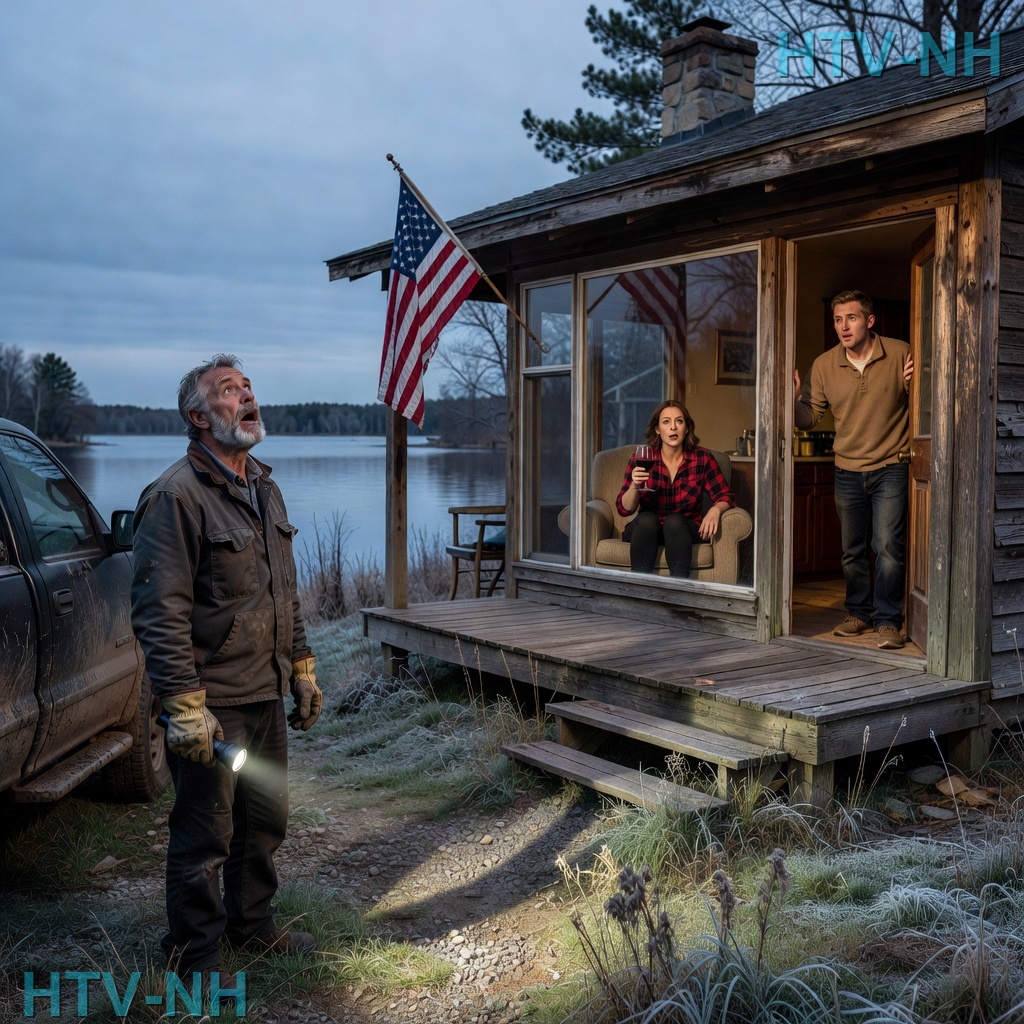
Three months ago, I watched the casket of my only son lower into the frozen ground. I thought the hardest part of my grief was behind me, but I was wrong. On a bitter, frost-covered November morning, I packed my truck and drove back to the isolated lakehouse in Vermont—a sanctuary I had spent years building with my own two hands, a gift I poured my heart into for his future. I was only supposed to be there to winterize the property and lock it down until spring.
But the moment my tires crunched onto the gravel driveway, my heart stopped.
Through the thick mist rising off the lake, I could see a warm glow. The lights inside the house were completely on. Someone was inside. Someone was walking through the rooms where my son’s memory belonged.
I didn’t storm the front porch. I didn’t reach for my shotgun. Instead, I sat in the darkness of my truck, pulled out my phone, and opened a secure app. Years ago, during construction, I had installed a state-of-the-art hidden security camera system that my son never even knew existed.
The Wolves In The Sanctuary
As the live feed buffered and the camera angles inside the living room finally cleared, the breath caught in my throat. My blood turned to absolute ice.
It wasn’t a random burglar or a drifter looking for shelter. Sitting on the couch, drinking from my son’s private collection, were the very people who had wept the loudest at his funeral just ninety days ago. They were laughing, going through his personal safe, and casually tossing his belongings into cardboard boxes like vultures tearing at a carcass.
In that exact second, a sickening realization washed over me. Some people don’t attend a funeral to pay their respects or say goodbye. They attend to scope out the estate, map out the logistics, and wait for the perfect moment to rob a dead man’s legacy.
The Silent Counter-Eviction
They thought the old builder was too broken by grief to ever come back here. They believed they had weeks to strip the house bare before anyone noticed. They had no idea that every whispered conversation about their greedy, malicious scheme was being recorded in high-definition audio right to my device.
I sat in my truck, watching the screen as my son-in-law and his accomplices celebrated their easy jackpot. I slowly put the truck in reverse, backed down the gravel road, and made a single phone call to the local sheriff—not just to report a break-in, but to set a trap that would completely destroy their lives before the sun even finished rising over the lake.
They wanted a free house, but they were about to get a prison cell.
————————————————————————————————————————
The first thing I saw was the lamp.
A warm amber glow spilled across the front windows of the lakehouse, soft and domestic, the kind of light that belonged to chili on the stove, boots drying by the mudroom, a football game murmuring low in the background. Not a locked house at the end of a private road in northern Vermont. Not a place that had been empty since the day we buried my son.
I killed the engine of my F-150 and sat there with both hands still gripping the steering wheel. The dashboard clock said 4:18 p.m. The sky had already gone that hard, metallic gray you get in November when daylight gives up early. Frost silvered the weeds along the shoulder. Beyond the stand of birch, Lake Elmore looked flat and cold as sheet steel.
Daniel had been dead eighty-nine days.
I had counted every one.
Three months earlier, I had stood in a church in Montpelier while people told me my only child had lived a good life, built a respected business, loved fiercely, laughed easily, hiked like he had been born on a trail. I had shaken hands, accepted casseroles, listened to words like tragic accident and untimely loss and God’s plan, and then I had gone home to Burlington and sat in a house so quiet it felt padded.
Now I was staring at lights inside the lakehouse I had built for him with my own hands.
And something inside me went cold before the November air ever could.
I had come up for ordinary reasons, or at least the kind of ordinary things grief leaves you with. Drain the pipes before the first hard freeze. Shut the storm windows. Check the crawl space. Pull the dock another few feet before the ice started to grip the shoreline. The little practical tasks that keep a place from falling apart when nobody’s living in it.
That was the lie I had told myself, anyway.
The truth was uglier and simpler. I wanted to be where he had been happy. I wanted to stand in a room that still held the shape of him and pretend, for an hour, that a man could keep loving someone back into existence if he kept enough of their things intact.
Instead, I was sitting in the dark with my truck idling and a lit house in front of me.
I should have called 911. Or the sheriff’s office. Or at least Phyllis Mercer, who lived around the cove year-round and noticed everything from behind her lace curtains.
But I didn’t.
Because grief had done something strange to me in those first months. It had hollowed me out in some places and sharpened me in others. I cried in grocery store parking lots. I forgot whether I had eaten lunch. I stood staring at unopened mail like it was written in a foreign language. But if something felt wrong—truly wrong—some older, harder part of me still woke up fast.
And what I felt, looking at that lamp, was wrong.
I shut off the truck. The sudden silence rang in my ears.
Then I opened the glove box and took out the flashlight.
—
The gravel road curled through the birch trees and ended in a little clearing where Daniel had once told me the house looked like something out of a magazine for people with more money than sense. He had said it standing on the unfinished porch with a nail apron around his waist, grinning at me under a Red Sox cap, sawdust on his jeans.
“Come on, Dad,” he’d said. “Look at this place. You gave me a catalog dream.”
“It’s pine boards and sweat,” I told him.
“Exactly. Which is more expensive now.”
That had been Daniel. He could make you laugh while you were carrying a beam too heavy for one man.
The lakehouse wasn’t fancy by Burlington standards, not compared to the glass-and-stone places farther south with automatic gates and boat lifts. It was cedar-sided, two stories, broad windows facing the water, fieldstone chimney, deep front porch. Strong bones. That’s what I cared about. Good bones, proper drainage, lines that would last longer than trends.
I’d built it over two summers with a small crew and a lot of weekends, mostly because Daniel had fallen in love with the property and mostly because I’d spent my whole life building things for other people. Strip malls. Additions. municipal offices. Dentist suites. A Marriott renovation off I-89. This one, I wanted in the family.
By the time I crossed the clearing, the frozen grass was crunching under my boots. I stayed off the gravel instinctively. No reason to announce myself if I didn’t know who was inside.
The side window gave me a clean angle into the living room.
For a second my brain refused to name what I was seeing.
A woman curled into Daniel’s couch. Sock feet tucked beneath her. A stemless wineglass on the side table. His red-and-gray flannel shirt hanging loose over black leggings. The TV casting blue light across her face.
Rebecca.
My daughter-in-law.
The widow who had clung to me in the church parking lot after the service and whispered, “I can’t go back there, Howard. I can’t. That house feels like a knife right now.”
The woman who had cried into my coat while I rubbed her shoulders and told her there was no right way to grieve, no timeline, no obligation to do anything that hurt too much.
The woman sitting comfortably in my son’s house, drinking wine, wearing my son’s shirt.
I stood there long enough for the cold to creep through the seams of my gloves.
Then she turned her head toward the kitchen and smiled at someone I couldn’t yet see.
A man stepped into frame, broad through the chest, sleeves rolled, moving with the kind of ease that doesn’t belong to a guest.
He put one hand at the small of her back as he passed.
Greg Masten.
Daniel’s business partner.
The same Greg who had come in from Chicago for the funeral, stood graveside with damp eyes, and told me, “Your son was the best man I ever knew.”
I stepped back so fast my heel caught in the dead leaves near the foundation.
And in that moment, standing in the dark outside my son’s house, something old and practical clicked into place.
Because there was one thing about that lakehouse nobody ever remembered.
Not even Daniel.
I had wired the whole place myself.
—
I’m not an electrician. Daniel used to tease me about that.
“Dad,” he told me one winter, laughing over a cup of coffee while I was crouched in the utility room with my spiral notebook and a headlamp, “you build beautiful things, but every time you mess with wires I get nervous.”
“You should be nervous,” I said. “That’s how respect works.”
He laughed and clapped my shoulder. “Fair point.”
What he didn’t know was that by then I had already spent six months teaching myself the smart-home system piece by piece. Motion sensors, smart locks, entry cameras, climate controls, a hidden hub, redundant hard-drive storage. I watched YouTube tutorials from men in garages in Ohio and women in Arizona who explained everything better than any manual ever written. I made diagrams in a five-dollar spiral notebook from Aubuchon Hardware. I labeled wires with painter’s tape and checked each line three times.
I did it because the place sat isolated. Because weather up there could turn nasty fast. Because if pipes burst or somebody forced a door, I wanted to know. Because fathers tell themselves a hundred small practical lies that are really just other names for love.
The central hub sat in the utility room behind a metal panel that looked like an ugly secondary breaker box. It had its own exterior door off the side yard. Separate lock. Separate key.
Daniel never needed it.
Rebecca probably never knew it existed.
I moved through the trees, keeping low more out of instinct than necessity. The utility-room door came open with barely a whisper. I had greased those hinges last spring after they started squealing in damp weather. Inside, the air smelled like cedar dust, cold concrete, and the faint metallic warmth of electronics running in a closed space.
The hub glowed softly from the shelf by the water heater.
Alive.
Recording.
My pulse thudded in my neck as I pulled over the stool and woke the monitor.
The system had been writing to the hard drive without interruption since late summer.
A neat stack of dates filled the screen.
I told myself I would check only the last twenty-four hours. Enough to understand why Rebecca and Greg were here. Enough to figure out whether I was looking at something ugly or something criminal.
I was still sitting there two hours later, my back cramped and my hands numb, staring at footage that had split my life into a before and after.
Because the affair was only the beginning.
—
The first clip that mattered was dated October 17.
Rebecca came in just after six in the evening carrying an overnight bag and a grocery tote. She unlocked the front door with a key I had never personally handed her, which meant she had copied one sometime in the past. Maybe before Daniel died. Maybe after. She moved through the kitchen like she belonged there.
Greg arrived forty-two minutes later.
No knock.
She opened the door before he even reached it.
He kissed her once on the mouth and once on the forehead and asked whether anyone had seen her car on the road in. She said no. He said good. She said, “Howard’s barely functioning. He won’t come up here before winter.”
I replayed that line three times.
Then I kept going.
Across six different evenings, in snippets caught by kitchen audio and the living-room camera and the front entry feed, the shape of it emerged. Not a fresh betrayal born of grief. Not two broken people making terrible choices after a tragedy.
A long-running relationship.
A practiced one.
The easy shorthand of people who had already told each other every lie they intended to keep telling the rest of the world.
“Daniel never noticed anything,” Rebecca said one night while chopping garlic at the island.
Greg laughed. “Because Daniel noticed skylines and site plans and whether a handrail was level. He didn’t notice people unless he loved them.”
“That’s not fair.”
“It’s true.”
She said nothing to that.
Another night, she found one of Daniel’s old sweatshirts in the hall closet and pulled it on against the cold. Greg watched her and said, “You have got to stop doing that. It’s weird.”
She rolled her eyes. “It’s practical.”
“No, it’s guilt.”
“Don’t psychoanalyze me in his house.”
His house.
Not ours.
Not mine.
His.
The word landed harder than I expected.
Then came the clip from November 3.
Greg was leaning against the kitchen counter with a beer in his hand. Rebecca was at the sink rinsing out a wineglass. Her voice was low, controlled in that way people get when they’re discussing something they’ve already decided but still don’t like hearing out loud.
Greg said, “I’ve been looking at the insurance timeline.”
She didn’t turn. “And?”
“The two-year contestability period runs out in March.”
The water shut off.
She dried the glass carefully with a dish towel. “So we wait until March.”
“We wait until March,” he said. “Then you file, payout clears, and we unload this place before anyone starts attaching memories to it.”
There are moments when the body understands before the mind does. I felt my lungs lock first. The meaning came after.
I leaned forward until my forehead nearly touched the cold edge of the monitor.
Contestability period.
Daniel had mentioned the policy to me a year and a half earlier in the casual way sons mention practical adult things when they start thinking in mortgages and taxes and long-term plans.
“Rebecca wants us better covered,” he’d told me over burgers at The Guild. “It’s not dramatic, Dad. It’s grown-up.”
I had laughed and told him grown-up was overrated.
Now I was listening to his widow and his business partner talk about the policy like a timer they had already built plans around.
And when I replayed that sentence a fourth time, one detail came crawling back from the funeral like something dragging itself out of mud.
Greg had mentioned the hike.
Almost casually.
“I was supposed to join him that weekend,” he’d said at the reception after the burial, coffee in one hand, sympathy arranged neatly on his face. “But my flight out of O’Hare got delayed. I kept thinking, if I’d made it in time…”
At the time, I had heard regret.
Now I heard positioning.
And the room around me changed shape.
—
Daniel was thirty-seven when he died.
The official account was painfully simple. He had gone hiking alone on a trail he knew well in the Northeast Kingdom, near an overlook on a ridgeline he’d walked since he was a boy. The sheriff’s report said his boot had snagged on exposed root or broken stone near the edge. He went over. Blunt-force trauma consistent with a fall. Found by two mountain bikers late that afternoon in a ravine below the overlook.
No signs of struggle. No clear reason to suspect foul play. Investigation closed in eleven days.
I had read the report at my kitchen table until the words blurred.
Then I read it again.
I asked questions in the quiet, apologetic way grieving fathers learn to ask questions when everybody around them is trying not to let them embarrass themselves.
Daniel was experienced.
Daniel was careful.
Daniel had been hiking those ridges since elementary school.
The deputy who took my call was kind, which somehow made it worse. He spoke to me gently, as if he could hear how badly I needed the world not to be random. He said accidents happened even to experienced hikers. Especially to experienced hikers, sometimes, because familiarity made people take one wrong step.
I thanked him.
Then I hung up and sat with the report in my hand until dark.
I wanted to believe it because the alternative was unbearable.
So I did what most people do when the truth asks more of them than they feel able to give.
I accepted the explanation that hurt in the simplest way.
Until the cameras gave me something worse.
I copied the relevant files to a thumb drive from the center console of the truck—one I had tossed there months earlier beside old receipts and a tape measure. Then I went farther back in the footage.
Late August. Early September. The weeks before Daniel died.
At 9:12 p.m. on August 24, Greg sat in the living room with Rebecca on the far end of the couch, both of them half-shadowed by the standing lamp. She had her knees drawn up under her and was speaking in a near whisper, but the hallway microphone caught every word.
“You’re sure about the overlook?” she asked.
Greg took a sip from a beer bottle. “I checked the topo map. The drop is enough.”
“That doesn’t answer the question.”
“It answers the only question that matters.”
She was quiet a beat. “He goes every September.”
“I know.”
“The same section?”
“The same section.”
Then, after a pause long enough to feel like fear, she asked, “And the trail conditions?”
Greg said, “Good footing until you need bad footing.”
I stopped the clip.
Not because I wanted to. Because I physically couldn’t breathe for a second.
The monitor hummed in the utility room. Somewhere inside the house, faint through the wall, the television laughed at a joke.
I understood then that I was no longer looking for proof of betrayal.
I was looking at the edge of murder.
—
I drove back to Burlington that night in complete darkness.
The road along the water blurred in the headlights. I don’t remember most of the drive, only snapshots: a gas station sign near Morrisville; my hands shaking so badly at a stoplight I had to grip the wheel with both palms flat; the sound of my own breathing when the truck cabin went too quiet.
At home, I set the thumb drive on the kitchen table and stared at it as if it might burst into flame.
I did not sleep.
Around 2:15 a.m., I made coffee strong enough to taste bitter even through the numbness in my mouth. At 3:40, I opened Daniel’s old hiking pack, which I had never fully unpacked after the sheriff returned his things. One glove. Trail map. protein bar gone stale. Receipts from a gas station in St. Johnsbury. I sat on the floor with those things around me and felt something close to shame.
Not because I had missed the affair. Not because I had trusted the wrong people.
Because some part of me had known the accident report didn’t fit, and I had let grief talk me out of my own instincts.
At dawn I made two decisions.
The first was that I would not go straight to the police—not yet. I knew enough about contractors’ disputes, insurance claims, and the general mess of human self-protection to understand that half-proof has a dangerous way of helping the wrong people. I had recordings suggesting fraud and conspiracy, maybe more. But I didn’t yet have a direct statement about Daniel’s death that any prosecutor would bet a case on.
The second was that I was going to get one.
By nine that morning I was in Montpelier, parked outside a brick ranch where my old friend Martin Carver lived with his second golden retriever and a garage full of fishing gear he claimed he would organize after retirement.
Carver had spent twenty-two years in the county attorney’s office. He understood evidence, procedure, weak links, and the many ways a true thing can still fall apart in court if you bring it badly.
He opened the door, took one look at my face, and said, “Come in.”
No questions. Just that.
That was one of the reasons we’d stayed friends.
I laid the thumb drive on his dining-room table between a bowl of clementines and a stack of unopened AARP mailers. He watched the footage without interrupting. Once, at the insurance clip, he muttered something under his breath I didn’t catch. At the August conversation, he sat back in his chair and rubbed a hand over his mouth.
When it was done, he said, “Jesus.”
We sat in silence a moment.
Then he looked at me squarely. “Howard, the insurance discussion is strong. The trail conversation is stronger. But neither one is a complete bridge by itself. You have motive. You have pre-planning language. You have post-death coordination. What you don’t yet have is the cleanest link between planning and execution.”
I said, “Meaning?”
“Meaning if you hand this to law enforcement right now, you may absolutely trigger a deeper investigation. But if they lawyer up immediately—and they will—your best leverage disappears unless the state can move fast enough to catch up. You need either physical evidence tied clearly to intent, or one of them to turn on the other.”
I stared at the footage paused on Rebecca’s face.
“How?” I asked.
Carver exhaled slowly. “I’m going to tell you what I would say if you were not my friend. I would say do not, under any circumstance, try to play detective.”
“And because you are my friend?”
He leaned back. “Because I am your friend, I’m going to say this once. Guilty people rarely confess to police first. They confess to pressure. To fear. To the belief that the other person is about to save themselves.”
I looked up at him.
He held my gaze. “You did not hear that from me.”
There it was.
The opening I needed and the warning I deserved.
—
I spent the next three days doing something that would have embarrassed the man I used to be.
I lied carefully.
First, I called Rebecca.
I waited until early afternoon when people tend to be between routines, relaxed enough to answer. When she picked up, I let my voice sound tired and frayed, the version of myself she had already decided I was.
“Hi, sweetheart,” I said.
“Howard. Hey.” Her voice went instantly soft. “How are you doing today?”
“Some days better than others.”
A pause. Sympathetic silence performed on cue.
Then I said, “I was thinking of heading up to the lakehouse sometime this week to winterize everything. Just wanted to make sure that didn’t feel… I don’t know. Like I was stepping on something that belonged to your grief.”
It was sentimental nonsense. Rebecca liked sentimental nonsense.
She answered right away. “No, of course not. I’m glad you’re taking care of it. I can’t quite face it yet.”
“Yeah,” I said softly. “I figured.”
She sighed into the phone, just enough to imply tears without giving me any actual sound. “That place was so special to us.”
Us.
I swallowed hard enough to make my next breath audible. “I found some of Daniel’s old architecture notebooks in a storage bin, by the way. From school. Thought you might want them.”
“Oh, absolutely.” Too quickly. “Yes, I’d love those.”
“I can drop them by next week.”
“That would be wonderful.”
Her voice stayed steady, easy, unsuspecting.
She did not know I had already been inside the utility room.
She did not know the house had been watching.
That mattered.
A week later I went to her apartment in Montpelier carrying three notebooks that genuinely had been Daniel’s. I wasn’t about to invent a prop that could unravel if she checked too closely. The building was one of those renovated mill properties where the hallways always smell faintly like laundry detergent and expensive candles.
She opened the door wearing a cream sweater and jeans, no visible trace of shock or sleeplessness. She hugged me. Made tea. Asked whether I was eating enough. I sat at her kitchen table while she moved through a domestic performance so polished it would have been convincing if I hadn’t seen her on my son’s couch wearing his shirt for another man.
At the right moment, I said casually, “Ran into Greg at the hardware store a while back.”
Her hand paused on the kettle handle.
“Did you?”
“Yeah. He said the kindest things about Daniel. Seems like he’s stayed in touch.”
Only the smallest shift in her face. A quick tightening around the eyes. Then gone.
“He checks in sometimes,” she said. “Mostly work stuff that still needs untangling.”
“Good,” I said. “People vanish after funerals.”
She set the tea down in front of me. “They do.”
I looked at the notebooks between us. “Daniel trusted him.”
Rebecca lifted her cup but didn’t drink.
“So did I,” I said.
Then I left.
Not because I’d gotten what I wanted.
Because I had seen enough to know where to press next.
—
The prepaid phone cost me thirty-nine dollars and some change at a gas station outside Barre, plus another ten for minutes I barely needed. I paid cash. Bought a coffee I didn’t drink. Pulled into a Shaw’s parking lot and sat there with the engine off while people pushed carts through slush and November wind.
I took Greg’s number from an old shared contact list on a family tablet Daniel had once synced for convenience. It still felt like trespassing, even then. But I was long past caring about the clean feeling of my hands.
The first text I sent was simple.
I know about the overlook.
No names. No explanation.
I removed the battery, broke the SIM free with my thumbnail, and dropped both into separate trash cans half an hour apart on the drive home.
Forty-seven minutes later, Rebecca called me.
That told me almost everything.
I answered on the third ring, voice thick with what I let her think was fatigue.
“Howard? Have you talked to Greg today?”
“Can’t say I have.”
A beat. “He got some strange message. Anonymous. He’s upset.”
“What kind of message?”
“Oh, probably some stupid prank. Something vague. People do sick things when they hear about tragedies.”
I let silence sit just long enough to make her fill it.
“He’s been under a lot of pressure with the company,” she added.
“I’m sure.”
“You haven’t said anything to anyone, have you? About… I mean, about the hike, or the insurance, or… you know. Things people could twist.”
There it was.
She caught herself too late and backtracked with a nervous little laugh. “I just mean people can be so weird after a death.”
I stared through the windshield at a shopping cart rattling across the lot in the wind.
“Rebecca,” I said gently, “grief makes everybody strange.”
Her exhale trembled. “Yeah.”
I softened my voice even more. “Are you okay, sweetheart?”
“Yes,” she said quickly. “Of course.”
But she had called me before she called police. Before she called a friend. Before she called a lawyer.
She had called to see what the grieving old man knew.
And once I understood the part they had assigned me, I realized how useful it was.
—
Over the next ten days, I sent seven more messages from three separate burners.
I varied the tone. Never enough detail to prove knowledge. Always enough to trigger memory.
He wasn’t as steady on that ridge as you hoped.
March won’t come soon enough.
The bottle mattered more than the fall.
Insurance clocks run out. So do secrets.
Daniel said a name before he went over.
That last one was a gamble. I had no idea whether Daniel had said anything at all. But guilt is a terrible collaborator. It fills in blank spaces faster than any imagination ever could.
The responses came indirectly.
Rebecca called twice under flimsy pretenses: asking whether I had found Daniel’s old watch; wondering if I planned to donate any of his drafting tools. Greg didn’t call at all, which was more revealing than if he had. Men like Greg only stay silent when they’re busy deciding which silence serves them best.
The cameras at the lakehouse showed the rest.
Yes, I kept watching.
Every evening they returned, I sat in the utility room or checked the cloud backup from home and watched fear do its work. Rebecca drank more. Greg paced. Their conversations grew clipped, then sharp, then openly hostile.
“Maybe it’s someone from the trail,” Rebecca snapped one night.
Greg barked out a laugh. “Who? The squirrels?”
“Stop.”
“No, you stop acting like panic is a plan.”
“You’re the one spiraling.”
“I’m spiraling because you keep calling Howard.”
Her face changed. “I’m managing him.”
He stared at her. “That is exactly the phrase a prosecutor would love.”
Another night, he said, “If you’d just left the policy alone for a year, we wouldn’t be talking about contestability like it’s a neon sign.”
She slammed a cabinet hard enough to rattle glassware. “Don’t act like this was my idea alone.”
“No,” he said. “Just the medication was.”
I froze the frame.
Medication.
It wasn’t a confession, not yet. But it was the first spoken thread that reached beyond the trail and toward method.
The number that had mattered before—two years—began to matter differently now.
Two years for the policy.
Two people carrying the secret.
Two ways this ended: one of them broke first, or both of them went down together.
I decided to force the choice.
—
The message that cracked them was the simplest one of all.
I sent it only to Greg.
She’s talking to an attorney. Save yourself before she does.
Then I waited.
Waiting, I learned over the course of Daniel’s trial, is its own form of labor. It looks passive from the outside, but it can grind a person down worse than motion. You wait for phone calls. For warrants. For lab results. For judges. For the sound of a key in a lock. For truth to stop circling and land.
In those first hours after I sent the text, I did practical things because practical things had saved me before. I changed the furnace filter. I reorganized a drawer of drill bits. I drove to Home Depot in South Burlington and stood in the plumbing aisle far longer than any sane person needed to compare copper fittings.
At 6:12 that evening, Greg showed up at the lakehouse alone.
I saw it on the front-entry feed from my laptop at the kitchen table.
No Rebecca.
He moved fast, agitated, searching drawers, opening cabinets, checking rooms as if he believed someone might actually be hiding there. Twenty-two minutes later, Rebecca arrived. They met in the kitchen.
“What did you do?” she demanded.
“What did I do?” Greg shot back. “What did you tell him?”
“I didn’t tell him anything.”
“Then why would anybody know about the bottle?”
There it was.
Not the whole truth. But enough truth to split blood from water.
Rebecca’s face went white. “Keep your voice down.”
“No.” He jabbed a finger toward her. “You think you’re smarter than everybody in the room, Rebecca. You always have. You picked the policy. You picked the trail. You got the pills. You said one muscle relaxer in his water would make him sloppy enough to sell an accident.”
She lunged closer and hissed, “And who put hands on him?”
The kitchen went silent.
Even through a screen, I felt something in me stop.
Greg took one step back. “You don’t get to put that all on me.”
“You were supposed to scare him. Just scare him.”
He let out a broken, disbelieving sound. “That is not what you said in August.”
I reached for my phone so fast I nearly knocked over the coffee mug beside the laptop.
Not 911.
Carver.
He answered on the second ring.
I said only, “I have it.”
His voice changed instantly. “Send nothing to anyone else. I’m calling my contact now.”
I already had the clips exporting.
For the first time since Daniel died, I felt the machinery of consequence start to move.
—
Law enforcement did not descend in a movie rush with sirens and shouted commands. Real cases, I learned, are less theatrical and far more methodical.
Carver called back within twenty minutes. A detective with Vermont State Police would meet me in person. Not tomorrow. That night.
I drove halfway to Montpelier with the thumb drive in my jacket pocket feeling heavier than metal. We met in the parking lot of a closed credit union, sodium lights washing the snowbanks yellow. The detective’s name was Lena Ruiz. She was maybe forty, sharp-eyed, all focus, no wasted language.
She watched the clips in her unmarked SUV while I sat in the passenger seat and kept my hands folded tight enough to ache.
When the kitchen confrontation ended, she paused the video and looked straight ahead for a long moment.
Then she said, “Mr. Fletcher, I need to ask you some very specific questions about chain of custody, system installation, dates, and whether anyone besides you had access to the recording hub.”
It wasn’t comfort.
It was better.
It was seriousness.
I answered everything. When I didn’t know something exactly, I said so. When I had a notebook or invoice or installation date to support it, I offered it. By midnight, they had copies of the original files, the system logs, my handwritten wiring diagrams, and the names of every person who had ever been given legitimate access to the property.
At 12:37 a.m., Detective Ruiz asked, “Did your son carry water on the hike?”
“Yes.”
“Recovered with the body?”
“I believe so. Standard belongings were logged.”
She nodded once. “That may matter.”
I thought of Greg’s voice.
The bottle mattered more than the fall.
A hook had set.
Now all I could do was wait for them to pull.
—
Three days later, Greg went to the state police barracks voluntarily.
Carver called me just after 10 a.m. I was at Ace Hardware buying weather stripping I didn’t need. I remember the smell of fertilizer and rubber floor mats and the absurdity of standing between snow shovels and extension cords when the world was about to split open.
“He came in on his own,” Carver said.
I stepped outside into cutting wind. “Why?”
“Because he believes Rebecca is about to save herself first.”
I closed my eyes.
Carver lowered his voice. “He’s talking. A lot.”
That was all he would say on the phone.
The fuller version came later through proper channels and the ugly drip-feed of a case becoming real. Greg admitted the affair had been going on for more than a year. He admitted Rebecca had pushed Daniel to increase coverage and praised the policy as responsible planning. He admitted they had discussed using the annual September hike because Daniel’s routine made the setting predictable. He admitted Rebecca had obtained muscle relaxants under false pretenses through a walk-in clinic in another county. He admitted Daniel’s water bottle had been dosed before the hike. He admitted there had been an argument near the overlook.
What he tried, at first, not to admit was intent.
That took longer.
According to Greg, the plan had been to make Daniel unsteady enough that a stumble would look plausible if opportunity presented itself. Rebecca believed one nudge to circumstance could become accident in the eyes of the world. Greg insisted he had only meant to “rattle” Daniel and that things went too far when Daniel, sluggish and confused from the drug, realized Greg had lied about the route and turned on him.
Men say a lot of things when they want guilt without full ownership.
What the evidence supported was simpler and uglier. They picked the place. They picked the timing. They weakened him. They took him to the edge.
The water bottle had been logged into evidence with Daniel’s recovered belongings, just as Ruiz suspected. At the time, nobody had tested it because the death had looked accidental. Now the contents went to the state lab.
And the case the sheriff had closed in eleven days opened like a trapdoor.
—
Rebecca was arrested on a Thursday morning in December.
I was not there.
That surprises some people when they hear the story now. They think revenge, if it comes at all, must arrive with a front-row seat. A dramatic look exchanged through glass. Some last sentence delivered in a courthouse hallway.
But by then I had learned something I wish I’d known in younger years: justice and spectacle are not the same hunger.
I did not need to see handcuffs.
I needed the truth to hold.
So I stayed home in Burlington. I made coffee. I stood at the sink watching sleet tick against the back deck railing. At 9:14 a.m., Carver called and said two words.
“It’s done.”
Then he added, “Greg too. Separate custody. Separate counsel.”
I sat down at the kitchen table where Daniel had once spread out his architecture-school sketches and explained, at fourteen years old, why everyone in America should stop building ugly civic buildings.
“You spend your life in places,” he’d said, tapping a pencil against a sheet of graph paper, “so why do we keep making places that look like nobody wanted them?”
I put my hand flat on that same table and let the weight of what was happening move through me without fighting it.
Not relief.
Not yet.
Just the first honest shift.
They weren’t untouchable anymore.
—
The weeks that followed were a lesson in how slow truth can still be, even when it has finally chosen a side.
The forensic toxicology report confirmed cyclobenzaprine in the water bottle at a level consistent with muscular impairment, slowed reflexes, and decreased balance within roughly thirty to sixty minutes of ingestion. Pharmacy records tied the prescription trail back to Rebecca through a false complaint lodged at an urgent care clinic two counties over. Digital records placed Greg’s phone near the trailhead despite his early insistence that he had missed the trip altogether. Deleted messages were recovered. Financial reviews turned up discussions of debt, cash-flow strain at the firm, and repeated references to “March” in contexts that had nothing to do with weather.
That number again.
March as deadline.
March as payout.
March as the month they thought would make them safe.
The contestability period on the policy had become their metronome. Two years. Wait it out. Let grief settle. Let suspicion die of neglect. Then file, collect, sell the lakehouse, move forward into a life they had started building while Daniel was still alive.
Every time that fact surfaced in court filings or lawyer language, it sickened me in a fresh way.
Not because of the money.
Because of the patience.
There is something especially chilling about evil that can wait politely.
—
The trial began the following fall and lasted eleven months in starts and stops, testimony and motions, bad weather continuances and the ordinary delay of a system trying to get everything exactly right because getting it almost right is not good enough when the stakes are this high.
I attended most days. Not because anyone required it. Because absence would have felt like handing over ground that belonged to Daniel.
Patricia Nolan sat beside me through nearly all of it. She had been Daniel’s college roommate at UVM—technically not a roommate after sophomore year, she corrected me once, because by then they had been in separate apartments but still shared groceries often enough to confuse accounting. Patricia was the kind of friend adulthood usually thins out but somehow hadn’t with her. She showed up in sensible boots, carried granola bars in her tote bag, and never once asked whether I wanted company before simply being there.
One morning outside the courthouse, she handed me a coffee and said, “He would be furious about all of this.”
I looked at her.
“Not the murder trial,” she said dryly. “The architecture. This building is hideous.”
I laughed for the first time in weeks.
That nearly undid me more than the tears had.
Inside, Greg testified under a cooperation agreement, voice thin and stripped of whatever charm he used to survive client dinners and contractor negotiations. He described the affair. The planning. The resentment Rebecca fed by degrees—Daniel’s obliviousness, Daniel’s control over his own business shares, Daniel’s optimism, Daniel’s refusal to be manipulated in the ways she wanted. He described the medication in careful language, as if precision could save him from disgust. He described the overlook, the argument, Daniel swaying and angry and trying to make sense of why his friend was acting strangely.
When the prosecutor asked, “Did the defendant Rebecca Fletcher know the plan involved physical harm to Daniel Fletcher?” Greg swallowed for a long time before answering.
“Yes.”
“When did she know?”
“Before the hike.”
“And what did she say?”
He shut his eyes briefly. “She said one bad step is all it takes.”
The courtroom went so quiet I could hear the court reporter’s machine.
That was the moment the room stopped entertaining possibilities and accepted what it was looking at.
A line had been crossed in public, and it would not be uncrossed.
—
I testified only once.
The prosecution did not need me for the forensic spine of the case. They had detectives, toxicologists, records custodians, digital experts, pharmacy witnesses, emergency-clinic personnel, and Greg himself to build that wall. What they needed from me was Daniel.
Not the victim.
The person.
So I took the stand, swore the oath, and answered questions about my son in a voice that sounded steadier than I felt.
I told them Daniel designed treehouses on graph paper before he was old enough to use power tools.
I told them he once argued for twenty minutes at age twelve that public libraries should feel more like living rooms because learning goes better when people aren’t made to feel small.
I told them he built a successful architecture practice because he believed beauty and usefulness had no business being separated.
I told them he trusted too easily sometimes, but not out of foolishness. Out of generosity.
The prosecutor asked, “What did you build the lakehouse for?”
My throat tightened.
“For him,” I said.
“And why there?”
“Because he loved that lake.”
“Did he hike often?”
“Since he was eight.”
“Was he reckless?”
“No.”
Just that. No speech. No performance.
No.
It landed harder than anything else I said all day.
On cross-examination, Rebecca’s attorney tried to paint me as a grieving father who had turned obsession into accusation. He asked whether I had installed the cameras without explicitly reminding every visitor of their presence. He asked whether the timestamps could drift. He asked whether grief had affected my judgment.
“Yes,” I said.
He paused. “Yes?”
“Grief affected my judgment the first time,” I said. “It made me accept an explanation that was easier to survive. That is not what happened here.”
He looked at me for a moment and then shuffled his papers.
He never got that footing back.
—
The verdict came on a wet October afternoon, clouds pressed low over Montpelier, leaves plastered to the courthouse steps like damp paper.
I had always imagined verdicts as clean moments. Guilty or not guilty. A hammer strike. A breath released.
In reality, they arrive through waiting again. Jurors filing in. Faces unreadable. The clerk speaking. Words that have to travel through air before they can touch a life.
First-degree murder.
Conspiracy to commit fraud.
Obstruction.
Guilty.
On all counts.
Rebecca did not collapse. She did not cry. She did not turn to scan the gallery for sympathy. She stood very still with both hands folded in front of her and looked ahead as if stillness itself were a final argument.
That frightened me more than any outburst would have.
Greg, by contrast, covered his face before the clerk had finished reading the rest.
Later, at sentencing, the judge gave Rebecca life without parole. Greg received twenty-two years on the reduced but still grave charges supported by his cooperation and role in the killing.
Outside, reporters waited in the cold with cameras and microphones and carefully arranged expressions meant to look compassionate while still chasing reaction.
Patricia slipped her arm through mine and steered me past them.
“Keep walking,” she murmured.
I did.
Not because I was above saying anything.
Because the only audience I cared about had already heard me inside.
—
Two months after sentencing, I drove back to the lakehouse alone.
February this time. The road narrowed by snowbanks on both sides. Birch trunks pale as bone against the woods. The lake frozen hard from shore to shore, wind scratching powder over the surface in long silver threads.
I parked in the same place I had parked the day I found the lamp on.
For a minute I stayed in the truck and watched my own breath fog the windshield.
A whole life had changed between those two arrivals.
On the first visit, I had come as a father trying to preserve a dead son’s house.
On the second, I came as the only person left who could decide what that house meant now.
The answer, I had learned, could not be memory alone.
Memory is holy, but it is not always enough to keep a place alive.
In the months after the trial, I had been talking with a nonprofit out of Montpelier that ran outdoor education programs for kids across the Northeast Kingdom—children who lived near forests, lakes, and trail systems but rarely had real access to them because access, in America, is often a matter of transportation, gear, adults with time, and whether your family can spare you for a weekend that doesn’t earn money.
They needed a site. Not glamorous. Not huge. Just safe, durable, and close enough to wildness that kids could feel it without being endangered by it.
The lakehouse was all of those things.
More than that, it had good bones.
Daniel would have liked that answer.
So I signed the papers.
Not a sale.
A donation.
I spent six weeks making repairs nobody had asked for because I knew where every draft lived and which stair tread had the faintest squeak and how much better the mudroom bench could be if somebody just rebuilt it with proper support. I replaced smoke detectors. Labeled switches. Patched trim. Sanded the dock rail smooth where weather had raised the grain.
And over the front entry, where the old house sign used to hang, I mounted a new cedar board I carved myself.
Fletcher Outdoor Center.
Open year-round.
Daniel’s name lived there without needing the whole world to know why.
That was enough.
—
The first Saturday in March, a van pulled up carrying eight kids, two staff members, duffel bags, donated boots, enough noise to wake the dead, and more life than that property had held since before the funeral.
I was there ostensibly to help with a sticky back door and a temperamental kitchen drawer. In truth, I wanted to witness the place becoming something other than a crime scene in my mind.
The kids tumbled out fast, all elbows and winter hats and overlapping questions.
“Can we go on the ice?”
“Do loons stay here in winter?”
“Is that a real canoe?”
“Who built this house?”
One of the staff members, a woman named Elise with an organizational clipboard and the patience of a saint, laughed and said, “One at a time, guys. One at a time.”
A boy around ten drifted away from the cluster and made his way to the dock. His coat was a little too big in the shoulders, probably donated, but his boots fit exactly right. Somebody had paid attention.
He stood at the edge of the dock looking out over the frozen lake with the solemn concentration children sometimes have when wonder hits them before words do.
I walked over and stood beside him.
After a minute, he asked, “Can you walk on it?”
“The ice?”
He nodded.
“On a lake this size, after weather like we’ve had?” I said. “Eighteen inches, give or take. Enough that people used to drive trucks on it back when everyone thought that was a great idea.”
He looked up at me. “You ever do that?”
I smiled despite myself. “Once. My son talked me into it.”
“What was his name?”
The question came so simply it didn’t hurt the way it usually did.
“Daniel.”
The boy looked back at the lake. “He must’ve really liked it here.”
“He did.”
We stood there a while in the clean cold, birches rattling softly in the wind, kids shouting behind us from the porch, someone inside dropping a pan and laughing about it.
I thought about Daniel at ten, seeing the lake for the first time and begging to know whether the winter ice could hold his weight. I thought about how many years can pass between one boy asking a question and another boy asking the same one on the same shore for entirely different reasons.
And I thought about the strange shape of legacy.
Not what is taken.
What remains useful.
—
People sometimes ask me now when I first knew Rebecca was lying.
The honest answer is that I didn’t know. Not in the clean, declarative way hindsight likes to pretend. There were moments, yes—small wrong notes I dismissed because love and grief are both excellent at editing reality into forms we can survive.
What I knew first was smaller than truth.
I knew the light was wrong.
I knew a house that should have been empty felt inhabited.
I knew my own body stiffened before my mind could explain why.
If there is any wisdom in that, it isn’t that everyone around you is dangerous. Most people are not. Most people are doing the best they can with the decency they have.
The lesson is narrower, harder, and more useful than that.
Pay attention when something in you resists the easy explanation.
Not every suspicion is wisdom. Grief can distort as easily as it reveals. But there is a difference between panic and perception, and I wish I had trusted that difference sooner.
I wish I had asked harder questions when Daniel died. I wish I had pushed the sheriff more. I wish I had looked at Greg’s almost-regret and heard what was underneath it. I wish I had understood that the people who benefit most from a loss deserve, at minimum, to be looked at clearly.
I live with those wishes.
But I also live with this:
On a gray Tuesday in November, I chose not to accept the easiest version of the worst thing that had ever happened to me.
That choice did not bring my son back.
It did something smaller and, in the end, more possible.
It made room for the truth.
And because it did, a house built for one man became a place that now belongs to many.
When the kids leave on Sunday afternoons, the porch is always chaos—half-zipped jackets, forgotten mittens, somebody asking for one more minute by the dock. Their voices carry over the cove long after the van doors shut.
That sound stays.
Sometimes I stand by the sign over the door after they’re gone and run my hand over the carved cedar letters. The grooves catch cold in winter, heat in July, damp in April thaw. Wood remembers weather. That’s what makes it worth working with.
So do people.
Daniel’s legacy isn’t the ridge, or the fall, or the courtroom, or the policy they thought would buy them a future.
His legacy is a shoreline full of noise.
A dock under small boots.
A good house with good bones still doing its job.
And if you’ve read this far, maybe you understand something I had to learn late: the truth does not always arrive when you beg for it. Sometimes it comes when you finally decide to look straight at what doesn’t fit and refuse to look away.
If a part of this stayed with you, hold onto it a little longer. Tell me where it hit you. Sometimes the quietest warning is the one that changes everything.
The first summer after the center opened, I learned that children ask the most direct questions in the world and almost never ask the one adults are bracing for.
They wanted to know whether the canoe rack had always been there. It had not. Whether bass hid under the dock in July. They did. Whether the old brass compass in the common room still worked. More or less. Whether somebody had really driven a pickup across the frozen lake. Yes, and it was exactly as stupid as it sounded.
What they did not ask, at least not right away, was why there were still hairline marks in the hardwood near the kitchen where one of the original chairs had scraped the floor too many times in the same place, or why the utility-room door had a stronger lock than anything else in the building, or why I had a way of going still for half a second whenever the lamps came on near dusk.
Children accept a place before they interrogate it.
Adults do the opposite.
That first summer was busy in the good, exhausting way work can still be when the work means something. The nonprofit sent weekend groups, then weeklong sessions. Some of the kids were from farm towns within an hour of the lake and had somehow still never learned to paddle. Some came from apartments over laundromats and hardware stores and knew every parking lot in their county but not one trail marker by name. Some were loud from the first minute and some moved through a room like they were apologizing for taking up space.
Daniel would have noticed all of them.
He always noticed the ones who made themselves smaller.
One afternoon in June, Elise found me under the back steps replacing a warped board that had finally annoyed me past tolerance. She crouched beside me in khakis and muddy sneakers and said, “You know you don’t actually have to fix everything the instant it starts to age, right?”
I tightened the screw another quarter turn. “That is a reckless philosophy for a person running a building.”
She smiled. “I’m serious, Howard. The kids don’t care if one board has character.”
“This board doesn’t have character. It has water damage.”
She laughed softly and sat down on the lowest step. “Okay. Fair.”
For a minute we listened to the voices carrying from the shoreline. Two counselors were trying to teach a knot-tying exercise that had devolved into competitive nonsense, which was apparently how most worthwhile education happened after lunch.
Then Elise said, a little more carefully, “You know you can say no if I’m overstepping.”
That is never a sentence people say before something easy.
I leaned back on one hand. “Go ahead.”
She looked out toward the lake instead of directly at me. “Do you ever regret keeping it?”
I knew what she meant. Not the ownership structure. Not the donation paperwork. The deeper question under it.
Do you regret letting this place go on existing after what happened here around it?
I sat with it longer than politeness required.
“No,” I said at last. “I regret almost losing it to the wrong meaning.”
She nodded once, as if that answer matched something she already understood. “That makes sense.”
I brushed sawdust off my jeans. “A lot of people think closure is when a place stops hurting. I haven’t found that to be true.”
“What have you found?”
I looked past her at the dock, the cove, the birch leaves trembling silver-side-up in the breeze.
“That a place can keep hurting and still become useful again.”
That felt true enough to keep.
—
In July, I got a letter from Rebecca.
Not from prison directly in the way movies make it look, with dramatic stamps and jagged handwriting telegraphing menace before you open the envelope. This one came through her appellate attorney’s office in Montpelier on standard letterhead, folded neatly, accompanied by a cover note stating that his client wished the enclosed personal communication to be delivered without expectation of reply.
I stood at my kitchen counter in Burlington turning the envelope over in my hands while the coffee maker hissed behind me.
I did not want to open it.
I opened it anyway.
The letter was six handwritten pages on yellow legal paper. Her handwriting remained exactly what it had always been—small, controlled, leaning slightly forward as if it were hurrying toward a conclusion. She did not confess. Not in the clean, courtroom sense of the word. She did something more irritating and, in some ways, more revealing.
She narrated herself.
She wrote that grief had distorted everything. That Greg had manipulated her. That Daniel had become “impossible to reach” in the last year of his life. That she had felt trapped in a marriage nobody from the outside understood. That she had made “terrible allowances” because she believed circumstances were moving beyond her control. That she thought, at first, Greg only meant to frighten Daniel into finally listening about the business, about the pressure, about the fact that “everyone depended on him and he never really saw what that meant for other people.”
I had to stop reading after that sentence and put the pages flat on the counter.
Because even then, even with life without parole already sitting on her shoulders, she was still reaching for the same thing she had always reached for.
A way to make responsibility sound communal.
Not I wanted.
Not I chose.
Everyone depended on him.
Everyone.
I poured cold coffee down the sink, made a fresh pot, and went back to the letter.
She wrote that she had loved Daniel once. I believed that part, which made the rest no easier to absorb. Human beings rarely become monsters by feeling nothing. More often, they become dangerous by deciding their feelings are the center of the moral universe.
On the final page she wrote, I know there is nothing I can say that will matter to you now, but I need you to understand that I never imagined it would happen the way it did.
That line sat in my hand like something oily.
Not it never should have happened.
Not I would take it back.
Only: it happened differently than I intended.
I folded the pages, slid them back into the envelope, and drove them to Carver’s house.
He opened the door in socks and a flannel shirt and took one look at my face. “Bad?”
“Useless,” I said, and handed him the envelope.
He read it at the dining room table while I stood at the sink staring into his backyard at a bird feeder I had repaired for him three years earlier.
When he finished, he set the pages down and let out a long breath through his nose.
“Well,” he said.
“That helpful legal term?”
“It means,” he said dryly, “she’s still trying to control the emotional frame of the story.”
I turned back toward him. “You think she believes any of it?”
He considered that.
“Parts of it,” he said. “People like Rebecca usually do. Not because the facts support them. Because self-preservation gets woven into memory until it feels like sincerity.”
I sat across from him. “Should I answer?”
“No.”
“That quick?”
“Yes.” He tapped the letter. “This isn’t remorse. It’s an access point. Even if she doesn’t know it consciously, she is testing whether she still gets to occupy space in your inner life on her terms.”
I stared at the pages.
“You don’t owe her your attention,” he said.
There are permissions you don’t know you need until somebody gives them to you plainly.
I left the letter with him.
I never read it again.
—
Greg wrote too.
His arrived in October, almost exactly one year after the verdict, from the correctional facility where he had been transferred to begin serving out the part of his life he had left. Unlike Rebecca’s, his was short. Two pages, blue ink, no attorney letterhead, no legal language, no architecture of excuses elaborate enough to live in.
He wrote that he was not asking forgiveness.
He wrote that he had started attending a victims’ accountability group inside and hated every minute of it, which made him suspect it was doing him some good.
He wrote that there was one detail from the day on the ridge he had not said out loud in court because once he said it, he would have to know himself as the man who heard it and still did what he did.
I felt my whole body go taut before I got to the next sentence.
Daniel had looked at him after the first surge of dizziness and said, “Greg, what did you give me?”
Not Who are you?
Not What’s happening?
Greg.
He had known.
At least in those last moments before everything broke apart, my son had looked at the man beside him and understood that the danger had a face he recognized.
I sat at the kitchen table with the page in my hand until the room went dark around me and the only light left was the one over the stove.
Have you ever read a single sentence that rearranged your grief all over again? Have you ever thought the worst part had already found you, only to realize pain still had one more room in the house?
I did not cry at first.
What I felt was stranger than that.
Not fresh horror. Not surprise. Something closer to terrible intimacy.
Because that sentence gave me Daniel not as body, not as evidence, not as victim, but as a mind still working in real time—confused, betrayed, trying to solve the impossible puzzle of why a friend had become a threat.
By the time the tears came, they came hard enough that I had to grip the edge of the table with both hands.
I called Patricia the next morning.
She answered with a yawn and said, “Please tell me you’re calling because you finally agree that Burlington bagels are a public disgrace.”
My laugh broke in the middle and became something else.
Her voice changed immediately. “Howard?”
“I got a letter from Greg.”
“Do you want me to come over?”
That was Patricia. No drama. No careful probing. Just movement toward the wound.
“Yes,” I said.
She was at my house forty minutes later with takeout coffee and egg sandwiches from a place in South Burlington Daniel used to like when he had early site visits. I handed her the letter. She read it once, then again.
When she looked up, her eyes were wet.
“Oh, Daniel,” she said softly, and that nearly broke me more than the letter itself.
We sat in silence for a while.
Then Patricia said, “You know what that sentence means to me?”
I shook my head.
“It means he wasn’t confused about himself. Even then.”
I looked at her.
She set the pages down. “He knew something was wrong. He named the person in front of him. He stayed Daniel all the way to the end.”
I had not thought of it that way.
I had only heard terror.
She heard recognition.
Both were true.
That is the trouble with grief. Two opposite things can fit inside it at once.
—
The second year after the trial, the center held its first autumn fundraiser.
I nearly skipped it.
Not because I didn’t support the work. Because public gratitude makes me itch. I know how to build a porch. I know how to square a window frame. I do not know what to do with a room full of folding chairs and cheerful people holding cider donuts while someone introduces me as the man whose generosity made all this possible.
Elise ignored my reluctance with the calm authority of a person who had wrangled six hundred forms from parents and therefore feared nothing.
“You don’t have to give a speech,” she told me.
“That feels like a trap.”
“It’s not a trap.”
“It has the structure of a trap.”
She smiled. “Two minutes. That’s all I’m asking.”
So I went.
They strung warm lights across the common room and set up borrowed tables with crockpots of chili, baskets of cornbread, and a silent auction made up of exactly the kind of Vermont offerings you would expect: maple syrup, handmade scarves, a guided paddle excursion, pottery, lift tickets somebody had donated from a family connection at Stowe.
Parents came. Teachers. Two state legislators. Carver, wearing the same blazer he had owned for at least a decade. Patricia. Phyllis from around the cove, who now claimed partial ownership of the center because she supplied half the zucchini bread and all the unsolicited shoreline opinions.
At one point I found myself standing near the fireplace with a paper cup of coffee while Phyllis told a couple from Morrisville exactly how bad the old dock posts had been before I rebuilt the anchoring.
“Not dangerous,” she said. “Howard never lets dangerous things stand. But shabby. And he knows I’m right.”
“I am not giving you that satisfaction,” I told her.
She patted my arm. “You already have.”
When Elise finally tapped her spoon against a mug and called the room to attention, I felt every instinct in me try to retreat toward the kitchen.
Then she said Daniel’s name.
Not theatrically. Just clearly.
The room changed.
She talked about access. About children who lived within driving distance of wilderness and still rarely got to touch it because access in this country gets decided by money and hours and who can take off work and whether a car starts in the morning. She talked about confidence growing in awkward, funny, measurable ways. The first child to paddle solo without panic. The first group to build a fire responsibly. The first teenager to admit she had never seen the Milky Way clearly before that dock.
Then she looked at me and said, “Howard, you don’t owe us anything tonight. But if you’d like to say a few words, we’d be honored.”
I stood because sitting there had suddenly become harder.
I did not prepare remarks. Prepared remarks would have made me a worse witness.
So I held the back of my chair and said the only true thing I had.
“I built this house for my son,” I said. “After he died, I thought for a while that the house had died too.”
The room was silent enough that I could hear the old baseboard heat clicking.
“But houses,” I said, “are like people. If the bones are good, they can sometimes survive more than you think they can.”
A few people smiled at that through the ache of it.
“My son loved this lake. He loved good design. He loved the idea that places should make people feel more possible, not less. I didn’t know what to do with this house after we lost him. Then I saw what happened when kids came through that front door and started treating the shoreline like it was theirs too.”
I looked around the room. At Phyllis. At Patricia. At Carver. At a row of parents leaning forward without meaning to.
“This place still hurts me sometimes,” I said. “But it doesn’t belong to what hurt it. Not anymore.”
I stopped there.
That was enough.
Maybe more than enough.
When I sat down, Patricia squeezed my shoulder once. Carver handed me a fresh coffee without comment. Across the room, a woman I didn’t know was quietly crying into a paper napkin while pretending not to be.
There are moments you don’t know are turning points until later.
That was one.
—
The third March after Daniel’s death, the date came around without warning and with warning both.
That is how anniversaries work once grief matures. They ambush you even when you’ve been tracking them for weeks. I knew exactly when the date was coming. I still found myself unsettled by stupid things the day before—an ad on the radio for hiking boots, a red flannel shirt on sale at Costco, a man in the supermarket laughing in Daniel’s exact register three aisles over.
I drove to the lake that morning before the staff arrived.
The road was muddy from thaw. Gray water ran in the ditches. Ice still clung to the shaded edge of the cove, but the center of the lake had gone dark and liquid again. There is a brief season in Vermont when everything looks undecided. Not winter, not spring, just the raw negotiation between them.
That morning matched me too well.
I walked out to the dock and stood where the boy had once asked me about the ice. The boards were damp under my boots. A pair of geese cut across the far end of the water, loud and unimpressed with human ceremony.
I said Daniel’s name out loud.
Just once.
It felt both insufficient and exactly right.
What would you do with a love that has nowhere left to go in its original form? Would you keep it locked up so it stayed pure, or would you spend it, even knowing spending changes it?
I used to think memory was an act of preservation.
Now I think it is also an act of distribution.
I stood there long enough for the wind to work through my jacket and then went inside to make sure the coffee urn was full before the middle-school group from Newport arrived. Sixteen kids. Two chaperones. One counselor already apologizing in advance for a child named Mason who, it turned out, was delightful and only needed somebody to give him a job the second he walked in.
By noon he was helping me carry split wood from the side rack to the covered bin by the porch.
“You work here?” he asked.
“Sometimes.”
“You the boss?”
“No. That’s Elise.”
He nodded as if that tracked. “You seem like a boss.”
“I’m old enough to enjoy hearing that.”
He grinned. “My mom says old men either know everything or absolutely nothing.”
“That is one of the wisest things I’ve ever heard.”
He stacked the wood carefully for about thirty seconds before curiosity took over. “Who’s Fletcher?”
I looked at the sign over the entry visible through the mudroom glass.
“My family name,” I said.
He considered that. “Was it your dad?”
“No.”
“Your grandpa?”
“No.”
He frowned. “Then why’d you name it that?”
Kids do eventually ask the real question.
I set down the armload of wood. “Because somebody in my family loved this place, and I wanted that love to keep doing something useful.”
Mason absorbed this for a moment in silence that looked almost adult.
Then he nodded once and said, “That’s actually cool.”
From a twelve-year-old boy hauling firewood in borrowed gloves, that was high praise.
I took it.
—
Not everything healed neatly.
That matters too.
There are stories people like because they flatten pain into sequence: terrible thing, brave decision, justice served, meaning restored. I understand the appeal. I really do. Clean lines are satisfying. Endings where every thread gets tied have a moral clarity most of us crave.
Life, unfortunately, is built more like an old house. Solid in one corner, drafty in another, carrying repairs you can see and others you only feel when the weather turns.
I still had bad nights.
Some came out of nowhere. Some were summoned by specifics too small to guard against. A certain bourbon on a restaurant back shelf because Greg had once brought that brand to a Fourth of July barbecue. A woman in a tan coat crossing Church Street with Rebecca’s exact walk. A phone call after 10 p.m. from an unknown number. Those still went through me like current.
I stopped hiking alone for a while.
That one surprised me the most. The woods had always steadied me. Not in a romantic, transcendence sort of way. In the practical way weather and trail grade and distance force a person back into their body. But after the trial, every overlook felt altered. Every loose root near a ledge became a question instead of terrain.
Carver noticed before I said anything.
We were at breakfast in a diner outside Waterbury where the coffee was decent and the bacon came too crisp unless you specified otherwise. He was buttering toast with offensive concentration when he said, “You haven’t gone out this fall, have you?”
I looked up. “Gone where?”
“Hiking.”
I should have lied, but something about diner light makes dishonesty feel more pathetic.
“Not much.”
He nodded like he had expected that.
Then he said, “You know avoidance is not the same as peace.”
“That sounds extremely retired-county-attorney of you.”
“It’s actually retired-county-attorney-who-has-been-to-therapy of me.”
I stared at him.
He sipped coffee. “What? You think old men don’t evolve?”
“I think you should have warned me before becoming emotionally literate.”
He smiled into his mug. “Too late.”
I looked out the window at the slush in the parking lot, the gas station across the road, a woman dragging a toddler in a puffy coat toward an SUV.
“I don’t like what the trails feel like now,” I said finally.
“There it is.”
“I know that’s irrational.”
“No,” he said. “It’s associative.”
I glanced back at him.
He set down the mug. “You had a place in your mind marked safe for decades. Then the worst thing in your life attached itself to that category. The body remembers categories faster than reason.”
“Is this from therapy too?”
“Some of it. Some of it’s from being old enough to know a few things.”
I poked at my eggs. “So what’s the wise answer?”
He shrugged. “Go back with someone. Pick an easy trail first. Don’t make it symbolic.”
That last part annoyed me because it was correct.
A month later, Patricia drove up from Montpelier in a Subaru full of snacks like we were heading into wilderness for six days instead of walking a beginner-friendly two-mile loop outside Stowe.
She got out in hiking boots and said, “Before you complain, understand that emotional support almonds are real.”
“Emotional support almonds?”
“Try to keep up.”
The trail was muddy and unremarkable and full of people with trekking poles they did not need. It was perfect.
At the first incline, Patricia looked over and said, “We are not here to prove anything.”
“Who’s we?”
“You. I’m naturally superior in all terrain.”
I snorted despite myself.
Halfway through, at a turnout that overlooked a stretch of bare trees and distant blue hills, I felt it—the old recoil, the tightening in the chest, the flicker of the mind toward the wrong September. Patricia did not crowd me. She only stood beside me, opened a packet of almonds, and said, “For the record, this view is good but not good enough for melodrama.”
I laughed. Then breathed. Then laughed again.
And just like that, the trail became trail for one minute instead of evidence.
That minute mattered.
So did the next one.
—
Years have a way of piling up quietly after catastrophe, and then one day you realize you have routines again.
Not the same routines. I do not think the original ones come back. But something grows in their place that deserves to be called a life if you are honest enough to name it.
Mine became divided between Burlington and the lake in a rhythm that would have amused Daniel, who used to claim I was only happy when I had a project in one pocket and a socket wrench in the other. I still took select construction jobs, mostly small ones by choice: built-ins, porches, repairs for people I liked, the occasional consulting work when some younger contractor wanted an opinion from a man who had made enough mistakes to recognize one early.
The rest of my time was split among the center, long coffee conversations that never would have happened before Daniel’s death because I had once confused love with constant usefulness, and the strange late-life practice of becoming known to children who had no reason to treat me as important except that I kept showing up.
That last one changed me more than I expected.
Kids trust consistency with an almost humiliating speed. Show up six weekends in a row, remember who hates oatmeal and who reads maps upside down, fix a busted snowshoe binding without acting like you deserve applause, and suddenly they begin handing you pieces of themselves as if you have always been there.
One teenage girl from Lyndonville, sharp as broken glass and twice as defensive, spent nearly three months refusing to answer me with more than one syllable. Then one rainy Saturday while we were sorting life jackets in the gear shed, she said, seemingly out of nowhere, “My stepdad says places like this are for rich kids pretending to camp.”
I handed her the next life jacket to inspect. “What do you think?”
She shrugged. “I think he says that every time there’s something he can’t give me himself.”
I looked at her then.
She met my eyes for exactly one beat before going back to the buckles.
“He may be embarrassed,” I said.
“He may be a jerk.”
“That too.”
She smirked despite herself.
After a minute she said, “You always answer like that?”
“Like what?”
“Like both things can be true.”
I thought about Rebecca. About Greg. About Daniel. About Patricia at the trail overlook. About Carver in his diner booth explaining the body remembers categories.
“Yes,” I said. “More than I used to.”
That became its own kind of teaching.
Not curriculum. Not a speech. Just the repeated demonstration that life is often held together by truths that push against each other without canceling out.
Daniel was trusting and perceptive.
I was broken and still capable.
The lakehouse was wounded and still useful.
Justice came late and still mattered.
Those pairings sustained me.
—
There is one room in the house I left almost entirely unchanged.
The utility room.
Not because I worship evidence. Not because I wanted a shrine to suspicion. The opposite, really. I left it mostly as it had been because I needed one place where the mechanics remained visible.
The hub still sits behind the panel. Updated now. Cleaner system. Better storage. Counselors use the feeds to monitor the entry in bad weather and make sure no one wanders toward the shoreline after lights-out. Sensible things. Ordinary things.
But sometimes, when I’m down there checking the backup battery or resetting a router after a storm flicker, I look at the little monitor glow and think about what it means that the truth, in this case, survived because a father once got obsessive over wiring diagrams and hinge grease and cloud redundancy.
Love is not always grand.
Sometimes it looks like overbuilding.
I keep Daniel’s old joke about my electrical work taped inside the cabinet door on a yellowing sticky note I found years later tucked into the back of the spiral notebook.
Dad, I love you, but you are absolutely one tutorial away from becoming a public hazard.
He had drawn a little skull beside it.
The first time I found that note after everything, I laughed so hard I had to sit down on the utility-room stool.
Then I cried until I couldn’t see the panel.
Now I mostly smile when I see it.
Mostly.
That counts as healing too.
—
Last winter, a boy I’d known through the center since he was ten came back at sixteen as a junior volunteer.
His name was Caleb. Thin in the way teenage boys often are right before they suddenly become large men overnight, all elbows again but longer now, voice halfway settled, hair perpetually one week past a haircut. He had first arrived angry at everything and suspicious of kindness in a way that made all the adults lower their voices around him. By sixteen he had become the kind of older kid younger campers watched automatically.
He was helping me salt the back steps after freezing rain when he said, “Can I ask you something weird?”
“You can ask. No guarantees on the answer.”
He grinned. “Fair. Why do you come every weekend if you already gave them the place? Like, you could just be done.”
I tossed another scoop of salt across the slick boards. “You asking why I didn’t donate the building and disappear?”
“Basically.”
I leaned on the shovel handle and looked out at the gray line of the lake.
“Because disappearing isn’t the same thing as finishing,” I said.
He absorbed that quietly.
Then he said, “Is that about your son?”
He knew enough of the story by then, the broad version staff gave older kids when they asked about the center’s origin and were mature enough not to turn it into campfire drama.
“Yes.”
He nodded. “My uncle died when I was eleven.”
I waited.
He scraped the edge of his boot against the step. “Everyone acted weird after. Like saying his name too much would make my grandma worse. So nobody said it. Which somehow also made it worse.”
That one hit close.
I set down the shovel. “A lot of adults confuse silence with protection.”
“Yeah.”
We stood there in the sleet-cold quiet.
Then I said, “Daniel.”
Caleb looked over.
“My son’s name was Daniel,” I said. “You don’t have to avoid it around me.”
He nodded once, serious in that instant far beyond his age. “Okay.”
Then, because he was still sixteen, he ruined the solemnity perfectly by adding, “For the record, your coffee is terrible and I think he’d want you to know that.”
I laughed right there on the icy steps.
“You know what? He probably would.”
Some kindness arrives disguised as disrespect.
I have learned to appreciate the distinction.
—
If there is a single image that holds the whole story for me now, it is not the courtroom.
Not the kitchen footage.
Not the lamp glowing through the front window that first November evening, though God knows that image still lives in me.
It is this:
late Sunday afternoon, after pickup, after the vans and Subarus have gone, after the counselors finish sweeping the common room and the shoreline falls quiet again. The lake flattened under the lowering light. A mitten left on the mudroom bench by mistake. The cedar sign above the door taking the weather exactly as wood should. And inside, on the big table Daniel once insisted had to be oversized because “good tables are where life actually happens,” a scatter of trail maps, crayons, half-finished hot chocolate, and one forgotten worksheet on knot-tying.
That table.
He helped me sand it.
Now it holds the weight of other lives.
I can live with that kind of continuation.
More than that, I am grateful for it.
Have you ever had to choose between keeping something untouched and letting it become useful again? Which would you have chosen if the untouched version was breaking your heart anyway?
I know what I would have said before all this. I would have chosen preservation. Lock the room. Guard the memory. Keep the loss clean.
I no longer believe clean is the highest form of love.
Sometimes love is letting other people leave fingerprints.
—
These days, when people find out enough of the story to ask whether justice brought peace, I tell them the truth.
Not peace. Not exactly.
Peace sounds finished.
What came instead was structure.
Before the truth came out, grief was loose in me. It moved furniture in the dark. It changed shape by the hour. It made me distrust my own instincts and then hate myself for distrusting them. Once the facts had names and dates and consequences attached, the pain did not disappear. But it had walls again. Floor joists. Load paths. It became something I could walk through without falling through every time.
That is the contractor in me talking, maybe. But it is also the truest language I have.
A thing can still be damaged and hold.
A thing can bear weight after almost failing.
A thing can be reinforced without becoming what it was before.
So can a man.
I still visit Daniel’s grave on the first Sunday of every month unless weather makes the roads irresponsible. I still tell him practical things while I’m there, as if he has any interest in drainage issues or whether the west-facing windows at the center need resealing before next winter. Sometimes I tell him about the kids. About Mason and the firewood. About Caleb and the bad coffee. About the girl who looked at the Milky Way like somebody had finally returned something that was supposed to have been hers all along.
And sometimes I stand there in silence because silence, handled honestly, is not emptiness.
It is company of a different kind.
I used to think the hardest part of losing Daniel was that there would never be anything good after it that I could bear to call good without feeling disloyal.
I was wrong.
The good did come back.
Not in replacement. Never that.
In addition.
That distinction saved me.
If you’re reading this on a quiet night somewhere, I suppose this is the part where I tell you what stayed with me most. Maybe it was the lamp in the window. Maybe it was the hidden cameras. Maybe it was the sentence Daniel spoke on the ridge, or the moment the truth finally cracked in that kitchen, or the sight of children running toward the shoreline of a house that refused to belong to cruelty forever.
For me, it changes depending on the day.
And if life has taught you anything about family, love, or survival, I hope you hold onto the first boundary you ever set that truly protected you. I have come to think those first boundaries are holy things. They often look small when we make them. Later, we realize they were the line everything else was built on.
As for me, mine began the night I stopped accepting the easiest explanation and started paying attention. Everything that came after—every truth, every consequence, every child laughing by that lake—was built on that line.